

Most remote workers treat caffeine like a reflex, not a strategy. You wake up, brew a cup, and keep pouring whenever focus starts to slip. But when your day is stacked with back-to-back video calls, that approach quietly wrecks both your afternoon sharpness and your sleep. Learning to plan caffeine around your remote meeting calendar is one of the highest-leverage habits you can build. It takes less than ten minutes to set up and pays off every single day in clearer thinking, steadier energy, and nights you actually sleep through.
Table of Contents
- Key Takeaways
- How caffeine actually works in your body
- Mapping your calendar before scheduling caffeine
- Step-by-step caffeine scheduling for remote workers
- Common mistakes that break your caffeine plan
- How to know your caffeine plan is working
- My honest take on caffeine and remote work
- Coffee built for how you actually work
- FAQ
Key Takeaways
| Point | Details |
|---|---|
| Know your caffeine half-life | Caffeine stays active for 4 to 6 hours on average, so your last cup directly shapes your sleep quality. |
| Set a hard cutoff time | Stop consuming caffeine at least 6 hours before your bedtime to protect sleep onset and continuity. |
| Match caffeine to high-stakes meetings | Time your dose 30 to 60 minutes before meetings that demand focus, not as a default all-day drip. |
| Eat before you dose | Pairing a small snack with caffeine prevents energy crashes and keeps meal patterns intact on heavy meeting days. |
| Track and adjust weekly | Monitor your sleep onset and afternoon energy for one week, then shift your schedule based on what you observe. |
How caffeine actually works in your body
Before you can plan caffeine around your remote meeting calendar with any precision, you need to understand what caffeine is actually doing once you swallow it. Most people know it wakes them up. Few know why, or how long it stays active.
Caffeine works by blocking adenosine receptors in your brain. Adenosine is the chemical that builds up throughout your day and makes you feel progressively sleepier. Caffeine does not give you energy directly. It just delays the signal that tells your brain to slow down. That distinction matters because it means caffeine is borrowing alertness from your future self, not creating it.
The timing math is where most people go wrong. Caffeine absorbs within 45 minutes and hits peak plasma levels somewhere between 15 and 120 minutes after you drink it. Its half-life sits between 4 and 6 hours for most people, but the range is genuinely wide. Some people clear caffeine in as little as 90 minutes. Others carry it for nearly 10 hours. Factors like oral contraceptive use, smoking history, and body composition all shift that number.

What this means practically: if you drink a cup of coffee at 3 PM and your half-life is 6 hours, half of that caffeine is still circulating at 9 PM. That is not a recipe for falling asleep easily.
Pro Tip: If you are unsure of your personal half-life, track your sleep onset time for a week while keeping your last caffeine dose at the same time each day. If you are lying awake for more than 30 minutes, your cutoff is too late.
Caffeine’s cognitive benefits are most reliable for vigilance and reaction time, which maps directly onto the kind of attention remote meetings demand. The effect is not uniform across all mental tasks, but for staying sharp during a fast-moving call, the science is solid.
Mapping your calendar before scheduling caffeine
Remote meeting caffeine management starts with your calendar, not your coffee maker. Before you change anything about what you drink, spend 15 minutes auditing your week.
- List your meeting blocks by type. Separate meetings that require you to speak, contribute ideas, or make decisions from passive listening sessions. These are your high-stakes windows where caffeine timing matters most.
- Note your natural energy dips. Most people experience a post-lunch dip between 1 PM and 3 PM. If your calendar stacks important calls in that window, you need a plan for it.
- Set your sleep anchor. Decide what time you want to be asleep, not just in bed. Work backward 6 hours from that time. Caffeine taken 6 hours before bedtime measurably delays sleep onset and disrupts sleep continuity. That is your hard cutoff.
- Identify your first real meeting. Many remote workers have a 9 AM standup but their first cognitively demanding call is at 11 AM. You do not need peak caffeine at 9 AM. You need it at 10:30 AM.
- Consider your current caffeine habits. If you drink coffee the moment you wake up, you are likely dosing before your cortisol peak, which naturally runs high in the first hour after waking. That first cup may be doing less than you think.
Pro Tip: Set a recurring 5-minute Friday calendar block to review next week’s meeting load and adjust your caffeine schedule accordingly. Treat it like a weekly planning ritual, not a chore.
The goal of this audit is not to restrict your coffee. It is to make every cup count. When you know exactly which meetings need your sharpest attention, you can time your doses to land at peak plasma levels right when the call starts.
Step-by-step caffeine scheduling for remote workers
Here is how to actually build a caffeine plan for virtual calls that works with your calendar rather than against it.
Step 1: Anchor your cutoff first. If you sleep at 11 PM, your last caffeine dose is at 5 PM at the absolute latest. Write this in your calendar as a recurring event. Everything else gets scheduled before it.
Step 2: Work backward from your highest-stakes meeting. If your most demanding call is at 2 PM, your dose should land around 1 to 1:30 PM. Caffeine needs 30 to 60 minutes to reach peak effect, so dosing right before a meeting means you are still waiting for it to kick in.
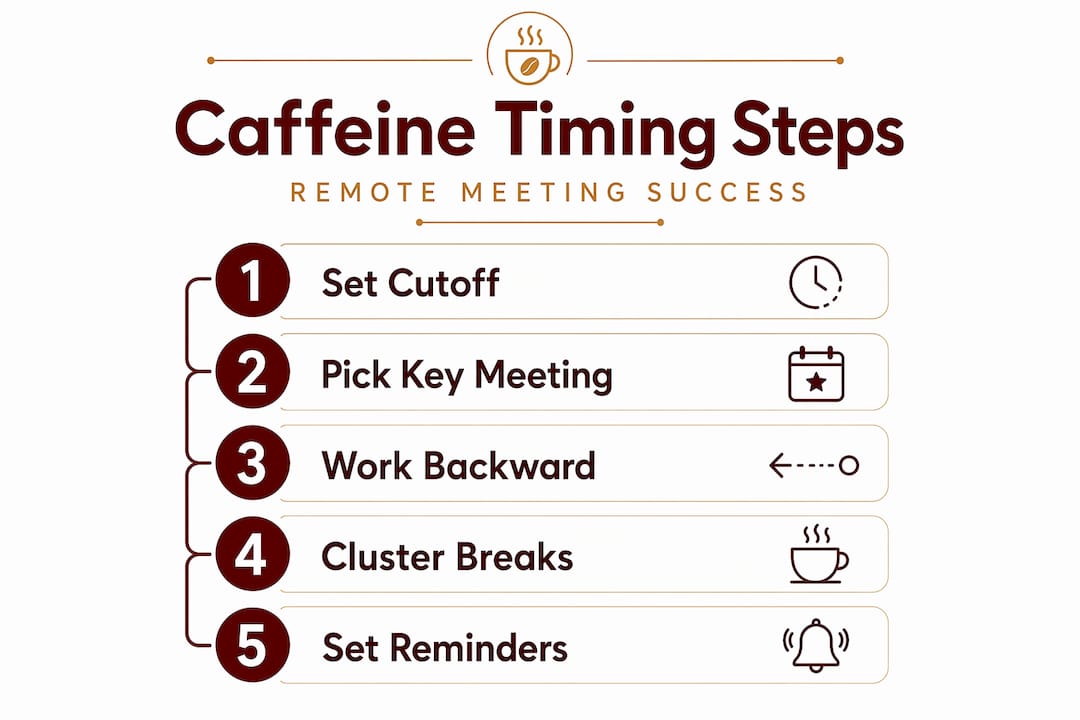
Step 3: Schedule coffee breaks around meeting clusters, not the clock. Rather than drinking at 8 AM, 10 AM, and 2 PM by habit, tie each dose to a specific meeting purpose. This is the core of optimizing caffeine intake for remote work.
| Meeting time | Recommended dose timing | Notes |
|---|---|---|
| 9:00 AM standup | 8:15 to 8:30 AM | Light dose, low stakes |
| 11:00 AM strategy call | 10:15 to 10:30 AM | Full dose, high focus needed |
| 2:00 PM client review | 1:00 to 1:15 PM | Full or half dose depending on cutoff |
| 4:00 PM or later | Skip or use half-caf | Protect sleep onset |
Step 4: Eat before you dose. Pairing a small snack with caffeine before your second cup of the day prevents caffeine from substituting for a meal. Yogurt, a handful of nuts, or a piece of fruit takes two minutes and keeps your energy stable for longer.
Step 5: Use calendar alarms. Set a reminder 30 minutes before each target dose time. You are not going to remember this mid-meeting. The alarm removes the decision entirely.
Step 6: Adjust your coffee format to your schedule. Instant coffee is ready in under two minutes, which makes it ideal for tight gaps between calls. Cold brew is pre-made and easy to portion, so you can control dose size without brewing anything. Half-caf blends work well for the 1 PM slot when you need alertness but cannot afford a full dose pushing into your sleep window.
Pro Tip: For back-to-back meeting days, use smaller redoses rather than one large afternoon cup. A half-dose at 12:30 PM and another at 2:30 PM keeps levels steadier than a full cup at 1:30 PM, and it keeps your last dose earlier.
Common mistakes that break your caffeine plan
Even a well-designed schedule falls apart in predictable ways. Here is what to watch for.
- Dosing too late because meetings ran long. This is the most common failure. A 3 PM call that runs until 4:30 PM tempts you to grab coffee at 4:45 PM. Late caffeine intake after 6 PM pushes sleep onset latency from under 20 minutes to over 46 minutes on average. Stick to your cutoff even when the day does not cooperate.
- Using caffeine as a meal replacement. Remote workers with packed calendars often skip lunch and drink coffee instead. This creates a reliable crash by 4 PM and makes sleep worse, not better.
- Ignoring withdrawal signals. If you skip your usual morning dose and get a headache by 10 AM, that is a dependence signal. Reducing caffeine by 25 to 50% over several days avoids the worst withdrawal effects if you want to recalibrate your baseline.
- Treating all meetings the same. A passive all-hands where you are listening for 45 minutes does not need the same caffeine support as a client pitch where you are presenting for 30 minutes. Stop dosing for every meeting and start dosing for the ones that matter.
“Caffeine is a tool, not a crutch. The moment you are drinking it to feel normal rather than to perform better, the plan needs to change.”
Recalibrate your schedule any time you notice two or more of these signs in the same week: difficulty falling asleep before midnight, afternoon irritability that was not there before, or a feeling that coffee is no longer working. These are signals that your timing, your dose, or both are off.
How to know your caffeine plan is working
The best times for coffee meetings are the ones where you show up sharp without lying awake at midnight. Here is how to verify that your schedule is actually delivering that.
- Sleep onset under 20 minutes. If you are falling asleep within 20 minutes of lying down, your caffeine cutoff is working. Anything longer than 30 minutes on a regular basis suggests your last dose is too late or too large.
- Stable energy through your afternoon meeting block. You should not be crashing at 3 PM or feeling wired at 9 PM. Steady, moderate alertness across your key meeting windows is the target.
- Fewer emergency doses. If you are no longer reaching for an unplanned cup at 4 PM just to get through the day, your earlier doses are timed well.
- Better appetite at meals. Caffeine suppresses appetite. When your dosing is timed around food rather than replacing it, you will notice actual hunger at lunch and dinner again.
Caffeine consistently improves vigilance and reaction time when timed correctly, but the benefits plateau quickly with excess intake. More coffee does not mean more focus. It means more noise in your system and worse sleep.
Give any new schedule at least one full week before judging it. Personalizing caffeine timing around your own half-life takes observation, not guesswork. Track your sleep onset time and your afternoon energy level in a simple notes app. Adjust by 30-minute increments until both feel right.
My honest take on caffeine and remote work
I have run heavy meeting days on too much coffee and too little food more times than I want to admit. What I have learned is that the problem is almost never the caffeine itself. It is the lack of intention behind it.
What actually changed things for me was treating caffeine the way I treat my calendar blocks: with a specific purpose and a defined end time. Once I stopped drinking coffee reactively and started scheduling it around my two or three most demanding calls of the day, my afternoon energy stabilized and my sleep improved within the first week.
The contrarian view I hold is this: most remote workers do not need more caffeine. They need better-timed caffeine. A single well-placed cup at 10:15 AM before a complex strategy session does more than three cups scattered between 8 AM and 2 PM. The adenosine-blocking mechanism is most useful when you deploy it deliberately, not constantly.
One thing I wish someone had told me earlier: eat something before your second dose of the day, every time. It sounds minor. It is not. The difference in sustained focus between a caffeinated and fed brain versus a caffeinated and empty one is significant.
Experiment with your schedule for two weeks. Your calendar changes week to week, and your caffeine plan should flex with it. The goal is not a perfect system. It is a responsive one.
— Jett
Coffee built for how you actually work
If your caffeine plan is going to hold up across a real remote workday, your coffee needs to be as flexible as your schedule.

Espritkaffe builds coffee for people who think in terms of timing and intention, not just taste. The instant coffee line is ready in under two minutes, which makes it the right call for a tight gap between meetings. The cold brew options are pre-portioned and easy to control, so you can dial in a half-dose for your 1 PM slot without brewing a full pot. For those who want functional energy with a lower caffeine ceiling, the medium roast mushroom blend pairs lion’s mane with a clean coffee base. Every format is roasted for clarity, not volume. Your schedule is already mapped. Now match your coffee to it.
FAQ
What is the best time to drink coffee before a remote meeting?
Drink your coffee 30 to 60 minutes before a high-stakes meeting so caffeine reaches peak plasma levels right when the call starts. Caffeine absorbs within 45 minutes and peaks between 15 and 120 minutes after intake.
How late is too late for caffeine on a remote workday?
Stop consuming caffeine at least 6 hours before your target bedtime. Research confirms that caffeine taken 6 hours before sleep significantly delays sleep onset and reduces sleep quality.
How do I handle back-to-back meetings without overdosing on caffeine?
Use smaller redoses spaced across your meeting blocks rather than one large afternoon cup. This keeps alertness steady while keeping your last dose early enough to protect sleep.
Can I drink coffee during a meeting instead of before it?
You can, but you will not get the alertness benefit during that meeting. Caffeine takes at least 15 to 30 minutes to begin working, so drinking it mid-call means the focus benefit arrives after the call ends.
How do I know if my caffeine timing is off?
The clearest signs are taking longer than 30 minutes to fall asleep, feeling wired in the evening, or crashing hard in the mid-afternoon. Adjust your last dose earlier by 30-minute increments until sleep onset improves.