

If you have ever wondered what is a coffee cupping and assumed it was reserved for industry insiders in lab coats, you are not alone. Coffee cupping, formally known as sensory evaluation or “cupping protocol,” is the standardized method professionals use to assess coffee quality. But here is what most people miss: cupping builds coffee knowledge that anyone can apply. This guide breaks down the process, the sensory attributes involved, the latest industry standards, and exactly how you can run your own session at home.
Table of Contents
- Key takeaways
- What is a coffee cupping, really?
- The coffee cupping process, step by step
- How the SCA’s Coffee Value Assessment changed cupping
- Cupping vs. other coffee tasting methods
- How to run your own cupping session at home
- My take on why cupping changed how I think about coffee
- Explore the coffees worth cupping
- FAQ
Key takeaways
| Point | Details |
|---|---|
| Cupping is for everyone | Coffee cupping is a standardized tasting method anyone can learn, not just professional cuppers or industry buyers. |
| Seven sensory attributes matter | Cuppers evaluate aroma, flavor, acidity, sweetness, body, aftertaste, and balance in every session. |
| SCA updated its standards | The new Coffee Value Assessment (CVA) changes how quality is scored, making evaluation more precise and flexible. |
| Cupping isolates variables | Using only coffee and water removes brewing variables, giving you a cleaner, more honest read of the bean. |
| Home cupping sharpens your palate | Regular practice, even with basic equipment, measurably improves sensory awareness and coffee appreciation. |
What is a coffee cupping, really?
Coffee cupping is a standardized sensory evaluation method used across the entire coffee supply chain, from farms in Ethiopia and Colombia to roasters in your city. Its origins trace back to the early twentieth century, when coffee traders needed a consistent way to compare beans from different regions without the results being skewed by personal brewing habits or equipment differences.
The idea was simple and brilliant: strip everything back to just coffee and hot water, then evaluate what you taste, smell, and feel in your mouth using a shared vocabulary.
Today, cupping underpins the entire specialty coffee industry. Producers use it to assess harvest quality. Exporters use it to verify consistency. Roasters use it to develop flavor profiles and track how a roast evolves over time. When a roaster in Portland talks to a farm in Guatemala, cupping gives them a shared tasting language that transcends geography and culture.
Here is why this matters for you as an enthusiast:
- Cupping teaches you what you are tasting, not just whether you like it
- It builds a vocabulary that makes you a better communicator about coffee
- It gives you a repeatable framework for comparing coffees side by side
- It sharpens your palate over time in a way casual drinking simply does not
Cupping is more than a professional ritual. It is the most honest way to understand what is actually in your cup.
The coffee cupping process, step by step
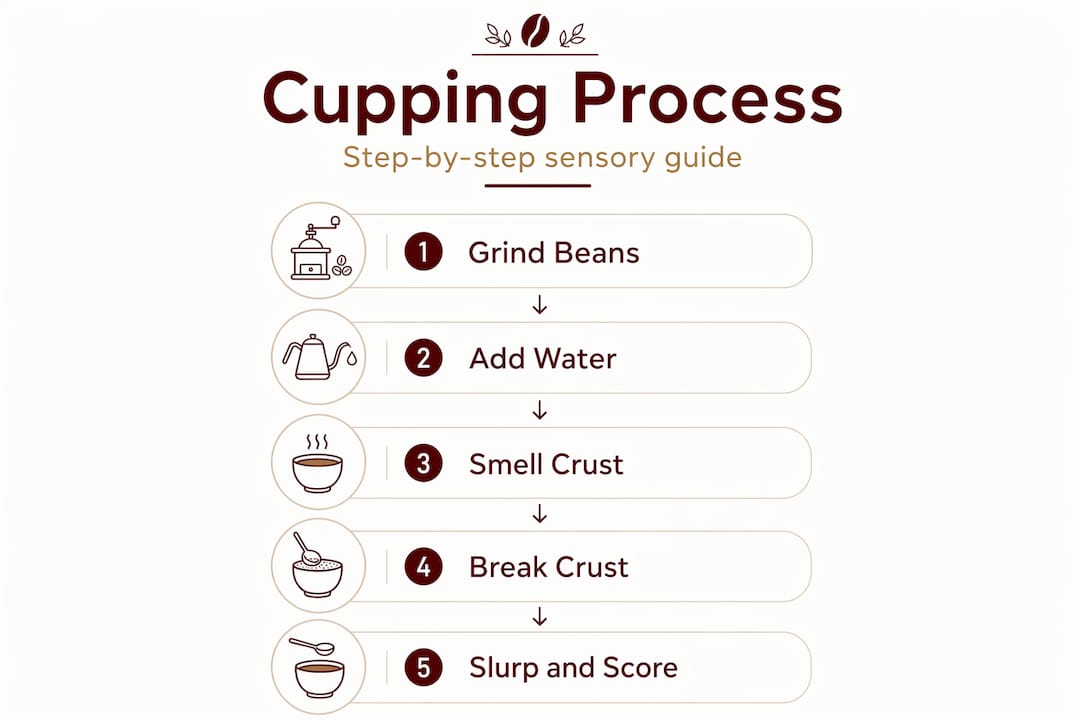
Running a proper cupping session is more structured than it sounds, but once you have done it twice, the steps become second nature. Here is how the coffee cupping process works in a standard session:
- Grind your coffee fresh. Use a medium-coarse grind, roughly the texture of raw sugar. The standard ratio is 8.25 grams of coffee per 150 milliliters of water. Consistency here is non-negotiable because any variation skews your comparison.
- Evaluate the dry aroma. Before adding water, bring your nose close to the grounds and inhale. This “dry fragrance” step reveals volatile compounds that disappear once water is added. Note what you detect: floral, nutty, chocolatey, fruity.
- Add water at 93°C (about 200°F). Pour it directly onto the grounds and start a four-minute steep. Do not stir.
- Break the crust. At four minutes, gently push the crust of floating grounds toward the back of the cup with your cupping spoon. Lean in as you do this. The burst of “wet aroma” released is one of the most revealing moments in the entire session.
- Skim and clear the cup. Remove the floating grounds with two spoons before tasting.
- Slurp your first taste. Use a cupping spoon to scoop a small amount and slurp it aggressively. This sounds impolite, but slurping aerates the coffee across your entire palate, enhancing your perception of flavor, acidity, and mouthfeel significantly.
- Evaluate across seven attributes. Work through each one methodically: aroma, flavor, aftertaste, acidity, body/mouthfeel, sweetness, and balance.
- Take notes and score. Write what you detect, then assign a score. Most professional forms score each attribute on a scale.
The SCA sensory protocols call out each of these attributes specifically because no single one tells the whole story. Acidity, for example, is not bitterness. It is the bright, lively quality in a Kenyan coffee that makes your mouth water. Body is the weight of the liquid on your tongue. Learning to separate these attributes is the whole point.
Pro Tip: Taste the coffee at multiple temperatures. Flavors shift dramatically as the cup cools. A coffee that tastes flat at 80°C might reveal stone fruit and caramel at 60°C.
How the SCA’s Coffee Value Assessment changed cupping
In 2023, the Specialty Coffee Association rolled out its Coffee Value Assessment (CVA) to replace its older cupping form that had been in use since 2004. The change is significant, and every serious coffee enthusiast should understand what shifted.
The SCA describes this as changing the evaluation’s “software,” not its “hardware”. The physical mechanics of cupping remain identical. What changed is how quality is judged and described.
A few key updates:
- Descriptive Assessment uses a “check-all-that-apply” approach borrowed from food sensory science. Rather than writing free-form notes, cuppers select from a structured set of descriptors, then rate their intensity. This makes results more precise and repeatable.
- Affective Assessment separates personal preference from objective quality scoring. A coffee can score high on quality and low on your personal preference, or vice versa. These are now treated as separate data points.
- Extrinsic Assessment considers factors outside the cup, like packaging, price, and branding. This was never formally part of the old form.
“The CVA does not change what we do at the cupping table. It changes what we learn from it.” This distinction matters because it means the new standards make cupping more accessible, not less. You do not need to master a complex new technique. You need to develop a more precise vocabulary and mindset.
For enthusiasts, the practical implication is this: the new CVA framework makes it easier to track your own preferences with more nuance. You can now clearly separate “this is a high-quality coffee” from “this is the style I personally enjoy.”
Cupping vs. other coffee tasting methods
You might wonder why cupping is necessary when you could simply brew a pour-over or pull a shot and taste that. The answer comes down to what you are trying to learn.
| Method | Variables introduced | Best use |
|---|---|---|
| Cupping | Minimal (water + coffee only) | Comparing bean quality across origins |
| Pour-over | Grind, pour rate, filter, temperature | Exploring brew technique impact |
| Espresso | Pressure, grind, dose, extraction time | Dialing in a single coffee for daily use |
| French press | Steep time, coarseness, sediment | Casual home drinking |
Cupping isolates sensory attributes by removing the variables that every brew method introduces. When you taste an espresso, you are partly tasting the extraction. When you taste a pour-over, you are partly tasting your technique. In a cupping session, you are tasting the coffee itself.

That is the core advantage. It is not that cupping is “better” as a brewing method. It is that cupping is the clearest lens available for coffee flavor profile assessment. For enthusiasts who want to understand why they prefer certain origins or roast levels, cupping provides answers that casual brewing cannot.
How to run your own cupping session at home
You do not need a professional lab. A methodical approach to home cupping improves sensory skills measurably, whether you are working alone or with a group of friends. Here is how to set up a session that actually teaches you something:
- Gather basic equipment. You need a kettle, a grinder, a scale, two or three bowls or wide mugs per coffee, cupping spoons (or large soup spoons), and a timer. That is it.
- Choose two to four coffees to compare. Contrasting origins work well: try an Ethiopian natural alongside a Colombian washed coffee. Distinct flavor profiles make the differences easier to detect.
- Prepare your tasting sheet. Draw a simple grid with columns for each coffee and rows for each attribute: dry aroma, wet aroma, flavor, acidity, body, sweetness, aftertaste, and overall balance. Write your impressions in real time, not after.
- Control your environment. No strong food smells nearby. No perfume. Neutral palate going in. Drink water between samples and avoid eating anything strongly flavored for at least an hour before.
- Taste blind when possible. Have someone else prepare the cups so you do not know which coffee is which. Blind tasting removes expectation bias in ways that are genuinely surprising.
Pro Tip: Invite friends and compare notes afterward. Sensory perception is personal, and discussing differences out loud builds your vocabulary faster than tasting alone. You will start noticing attributes you previously ignored.
Common pitfalls to avoid: tasting too hot (your palate cannot distinguish nuance above 70°C), using stale coffee (always cup within two weeks of roast date), and rushing the process. Cupping rewards patience.
My take on why cupping changed how I think about coffee
I spent years believing I had a developed palate because I drank a lot of coffee. Cupping proved me wrong in the best way possible. The first time I sat down with a structured cupping session, I realized I had been tasting in the same grooves for years without genuinely exploring what was in the cup.
What surprised me most was the role of acidity. I had always associated it with something negative, sourness or harshness. Cupping taught me to separate pleasant, bright acidity from actual defects. A well-evaluated coffee origin tells a completely different story once you have that distinction.
I also think cupping is underrated as a mindfulness practice. You cannot slurp from a cupping spoon and think about your inbox at the same time. The process demands presence. That is not a coincidence. Coffee at its best has always been about a pause, a reset, a moment where you actually pay attention.
My honest opinion: every coffee enthusiast should do at least one structured cupping session before deciding they know what kind of coffee they like. You will almost certainly surprise yourself.
— Jett
Explore the coffees worth cupping
If cupping has sparked your curiosity, the next logical step is getting coffees with enough character to make the evaluation worthwhile. Espritkaffe’s lineup is built exactly for that. The medium roast mushroom blend offers layered earthiness and subtle sweetness that rewards careful sensory attention. For something with more weight and depth on the palate, the dark roast version delivers the kind of body and aftertaste that make cupping genuinely interesting. Browse the full Espritkaffe coffee collection to find a range of roast profiles ready for your next session.
FAQ
What is coffee cupping in simple terms?
Coffee cupping is a standardized method for evaluating coffee by steeping grounds in hot water and tasting the result without any brewing equipment. It assesses attributes like aroma, flavor, acidity, body, and aftertaste in a consistent, repeatable way.
How is cupping different from regular coffee tasting?
Regular tasting is informal and influenced by brew method, equipment, and personal habit. Cupping removes those variables by using only coffee and water, giving you a direct read on the coffee’s actual flavor profile.
Can beginners do a coffee cupping at home?
Yes. You need a scale, a grinder, hot water, and wide cups or bowls. The SCA protocols are publicly available, and even a simplified version of the process builds real sensory skills over time.
What does the SCA’s CVA mean for coffee cupping?
The CVA updated how quality is scored and described, separating objective quality from personal preference. The physical process of cupping stays the same, but the evaluation framework is now more precise and accessible.
How many coffees should I compare in one cupping session?
Two to four coffees is the ideal range for beginners. Enough to notice meaningful differences, but not so many that palate fatigue sets in and everything starts to taste the same.