

Good flavored coffee, in the specialty sense, means beans whose natural tasting notes are clearly identifiable, well-aligned with mouthfeel, and balanced across sweetness, bitterness, and acidity. No syrups, no added flavorings. The Coffee Flavour Wheel, developed with the Specialty Coffee Association (SCA), is the standard reference for naming those notes. Before you read further, run this quick check on any bag you’re considering:
- Roast date visible? If it’s missing, pass.
- At least two identifiable tasting notes listed? Good coffee clears this bar.
- Mouthfeel described or implied? Silky, round, or clean all signal intentional roasting.
- Tastes balanced? No single note should dominate to the point of masking the rest.
Key Takeaways
Good flavored coffee means specialty beans with at least two identifiable, well-aligned natural tasting notes, a pleasant mouthfeel, and balanced tastes across sweetness, bitterness, and acidity.
| Point | Details |
|---|---|
| Natural tasting notes only | Good flavored coffee means identifiable natural notes, not added flavorings. |
| Sensory baseline | Look for at least two identifiable aromas, pleasant mouthfeel, and alignment between taste and aroma. |
| Roast date transparency | A visible roast date on the bag is the minimum trust signal; no date is a red flag. |
| Match profile to drinker | Comfort seekers want low-acid and chocolate notes; curious tasters want experimental processing. |
| Espritkaffe | Roasts to order with certified clean beans and a roast date on every bag. |
Table of Contents
- What makes good flavored coffee taste the way it does?
- How to use the Coffee Flavour Wheel to find natural tasting notes
- A simple grading rubric for buying or sampling
- Which natural flavor profiles suit different drinker types?
- How roast date and post-roast maturation affect what you taste
- What to check before you buy: a practical shopping checklist
- How to brew so the natural flavors actually show up
- How to store beans so the flavor lasts
- A roaster’s perspective on what “good flavored coffee” actually means
- Espritkaffe: freshly roasted beans with natural tasting notes
- Sources
What makes good flavored coffee taste the way it does?
United Baristas’ tasting guide lays out three non-negotiable traits: pleasant mouthfeel, harmonious balance of tastes (sweetness, bitterness, acidity, umami, and salt), and strong alignment between what you taste and what you smell. A coffee that smells like ripe peach but tastes flat and bitter has failed the alignment test, regardless of how interesting its origin sounds.
The flavor count gives you a rough grade. Two identifiable aromas or flavors put a coffee in the “good” category. Three or more push it toward “great.” When several distinct, well-aligned notes show up together, you’re in outstanding territory.
The Coffee Flavour Wheel maps these descriptors visually, moving from broad categories at the center (fruity, floral, nutty) outward to specific notes (blood orange, jasmine, hazelnut). Alignment means those outer-ring descriptors match what your palate actually registers in the cup.
Pro Tip: Taste the same coffee hot, then again once it cools to around 130°F. Aroma compounds shift as temperature drops, and a well-aligned coffee will still hold its character at both temperatures. If the flavor collapses when cool, the alignment is weak.
How to use the Coffee Flavour Wheel to find natural tasting notes
Cupping is the standardized method professionals use to isolate a bean’s intrinsic character. It strips away brew-method variables with coarse grounds, a hot-water steep, and no filter. You can run a simplified version at home in under 20 minutes.
- Grind coarse (similar to coarse sea salt) and measure roughly 8.25 grams per 5.5 oz of water.
- Pour water just off the boil (around 200°F) directly over the grounds and steep for four minutes.
- Break the crust by pushing the grounds aside with a spoon. Lean in and inhale. Write down the first two words that come to mind.
- Skim the grounds and let the cup cool for two more minutes, then slurp a spoonful across your whole palate.
- Start broad on the Flavour Wheel. Is it fruity? Nutty? Floral? Then narrow inward: citrus or berry? Lemon or orange?
- Note the finish. Does the flavor linger cleanly, or does it drop off fast? A long, clean finish is a quality signal.
- Record three things: the two or three dominant notes, the mouthfeel (thin, round, heavy), and whether the aroma matched the taste.
A washed Ethiopian will often show citric brightness and bergamot. A natural-process Ethiopian tends toward stone fruit and fermented berry. Those patterns connect origin and processing to what ends up in your cup, and recognizing them makes reading a roaster’s tasting notes useful rather than decorative.
A simple grading rubric for buying or sampling
The SCA’s 100-point scoring system sets “specialty” at 80 or above. Scores from 85 to 89.99 qualify as excellent; 90 and above is outstanding. Attribute scores covering fragrance, flavor, acidity, body, and balance show exactly where a coffee’s strengths sit.
| Grade | Identifiable flavors | Balance | Alignment | Body | SCA-style score |
|---|---|---|---|---|---|
| Good | 2 | Adequate | Partial | Present | 80–84 |
| Very good | 2–3 | Solid | Clear | Pleasing | 85–86 |
| Excellent | 3–4 | Strong | Consistent | Distinct | 87–89 |
| Outstanding | 4+ | Exceptional | Full | Memorable | 90+ |
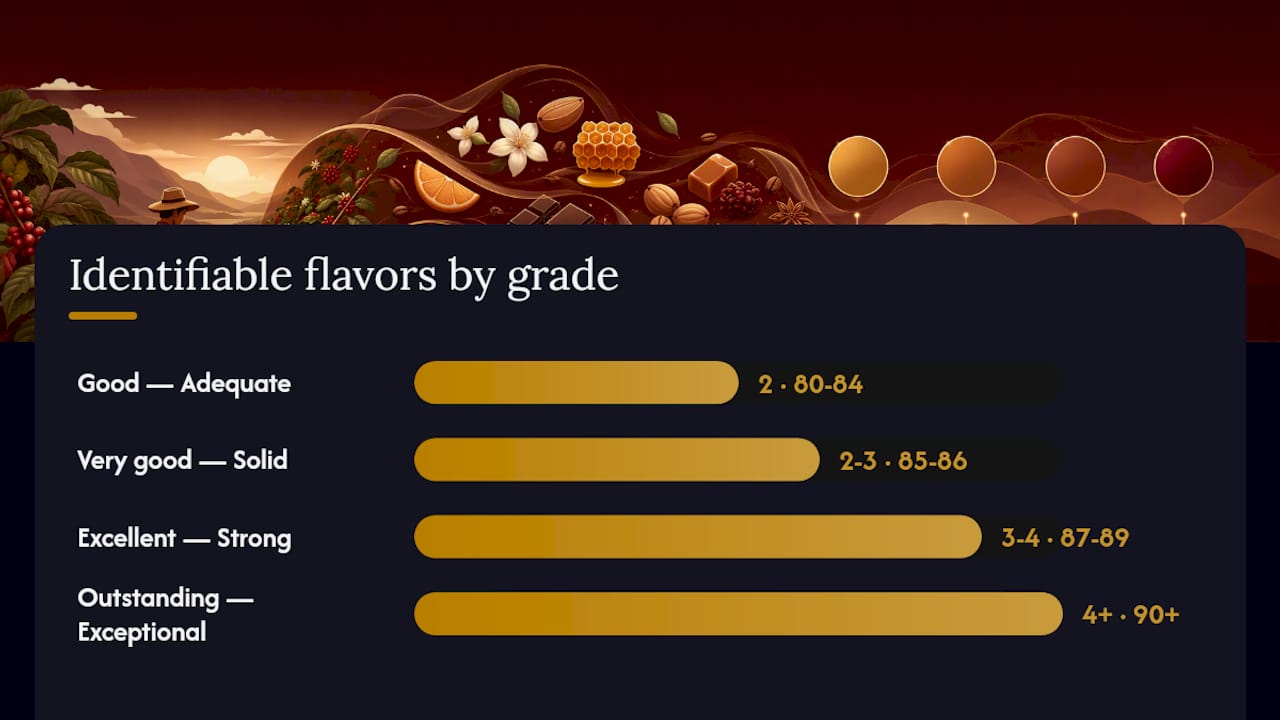
When you read a roaster’s tasting notes, count the descriptors and check whether they span more than one flavor family. Two notes from the same family (say, lemon and lime) count as one. Two notes from different families (citrus and dark chocolate) count as two. Reject any bag whose notes read vague (“smooth,” “rich”) with no origin or process information to back them up. Green-bean defects and moisture outside the optimal 10–12% range produce off-flavors that no roast level can hide, so defect-free sourcing is the foundation of every grade above.
Which natural flavor profiles suit different drinker types?
Not every great coffee is great for every drinker. Alignment matters, but so does fit.
Comfort seekers want low acidity, a sweet, full body, and notes that feel familiar: chocolate, caramel, toasted nuts. Brazilian naturals and medium-roast Colombian blends hit this squarely. For office environments, this profile gets the widest acceptance with the least explanation required.
- Look for: natural or honey process, medium roast, tasting notes in the chocolate/nut/caramel family
- Avoid: high-acid washed Kenyans or experimental ferments
Classicists want textbook origin clarity. A clean washed Ethiopian with bergamot and lemon, or a Guatemalan with brown sugar and stone fruit. They read the bag carefully and notice when a roaster’s notes don’t match the cup.
- Look for: washed process, single-origin, roast date within four weeks, precise tasting notes
- Avoid: blends with no origin breakdown or vague “smooth and balanced” copy
Curious tasters actively seek the unexpected. Anaerobic ferments, carbonic maceration, rare varietals. They’re the ones who’ll order a Bourbon cultivar specifically because it’s different from Typica.
- Look for: experimental processing, limited lots, detailed crop-year information
- Avoid: anything described as “approachable” or “everyday”
How roast date and post-roast maturation affect what you taste
A Springer study on post-roast maturation found that A large proportion of participants could tell apart beans roasted one day prior from beans matured several months later, but there was no significant overall preference for fresh over matured. The preference split was roughly even and statistically indistinguishable. That result matters for buyers: “freshly roasted” is a transparency signal, not a guaranteed quality advantage.
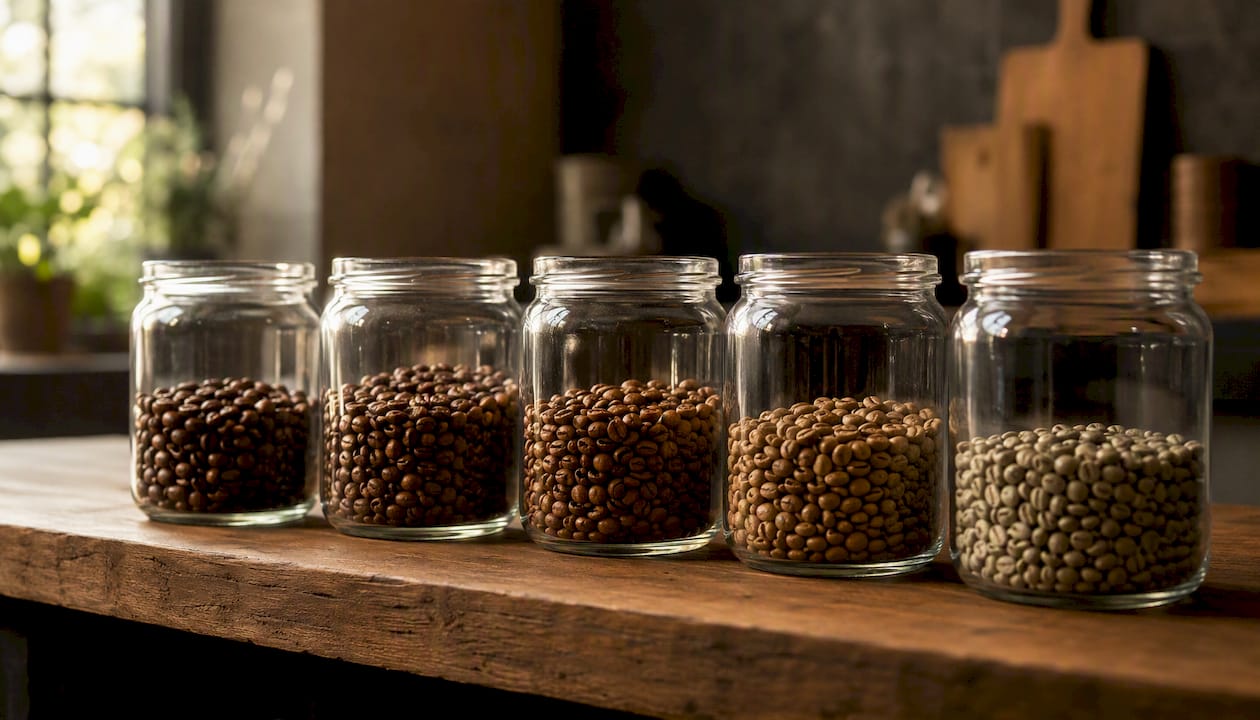
What actually changes during maturation is chemistry. CO₂ degasses rapidly in the first 5–14 days after roasting, and that CO₂ affects perceived acidity and extraction behavior. Espresso typically benefits from 7–14 days of rest after roasting; filter coffee often tastes cleaner at 5–10 days. Aroma compounds oxidize over longer periods, which is why a bag left open for three weeks tastes flat regardless of its original score.
Packaging tells you a lot. A one-way valve bag with a visible roast date is the minimum standard worth trusting. No roast date, or a “best by” date with no roast reference, is a red flag. Roast level also affects how quickly a coffee peaks: lighter roasts tend to develop flavor over a longer window; darker roasts peak faster and fade faster.
What to check before you buy: a practical shopping checklist
- Roast date: printed on the bag, not just a best-by date
- Origin and process: country, region, and washed/natural/honey
- Varietal and altitude: signals traceability and flavor potential
- Tasting notes: at least two, from different flavor families
- Crop year: “current crop” with no year is a buyer risk; ask for it explicitly
- Defect tolerance: for specialty lots, zero primary defects is the standard
- Moisture spec: optimal green-bean moisture sits at 10–12%
- Price range: expect $18–$30 per 12 oz for quality single-origin; blends run slightly lower
Questions worth asking a roaster: When was this roasted? What’s the processing method and crop year? Do you have a cupping score or sample sheet? What’s your defect tolerance on green sourcing? How do you recommend brewing this specific lot? A roaster who answers these without hesitation is worth trusting. One who deflects or gives generic answers probably can’t.
Coffee assorted packs are a practical way to sample multiple profiles before committing to a full bag, especially useful for business buyers setting up an office program.
How to brew so the natural flavors actually show up
The brew method shapes which flavor traits come forward.
- Filter (pour-over, drip): best for showcasing clarity and distinct tasting notes. Use a 1:15 to 1:17 coffee-to-water ratio by weight, medium-fine grind, water at 200°F.
- AeroPress: good for body and sweetness; compresses flavor into a shorter brew. Try 1:12 ratio, medium grind, two-minute steep, slow press.
- Espresso: concentrates everything, including flaws. Use 1:2 ratio (dose to yield), fine grind, 9 bars of pressure, 25–30 second extraction.
Common mistakes that mute natural flavors: grinding too coarse for filter (under-extraction, sour and thin), water too hot for light roasts (bitter and harsh), stale beans brewed as if fresh (flat and papery). If the cup tastes one-dimensional, grind finer before changing anything else.
Pro Tip: Brew the same beans as both a pour-over and an AeroPress on the same morning. The pour-over will show you the top notes; the AeroPress will show you the body. Together, they give you a complete picture of what the coffee can do.
How to store beans so the flavor lasts
- Airtight container, away from light and heat. A ceramic or opaque canister beats a clear jar every time.
- One-way valve bag sealed between uses if you’re not transferring to a canister.
- Grind only what you brew. Pre-ground coffee loses volatile aromatics within 30 minutes of grinding.
- Practical shelf life: peak flavor runs 2–4 weeks post-roast for filter; 7–21 days post-roast for espresso. After 6 weeks, most specialty coffees taste noticeably flat.
- Freezing: only freeze in airtight, single-use portions. Repeated freeze-thaw cycles accelerate oxidation and degrade flavor faster than room-temperature storage.
For business buyers managing multiple users: buy in two-week quantities, store in a single sealed canister, and label the roast date on the container. Consistency across a team depends on everyone drawing from the same batch under the same conditions.
A roaster’s perspective on what “good flavored coffee” actually means
There’s a version of this conversation that goes sideways fast: someone asks for “good flavored coffee,” and the industry hands them a bag of hazelnut-sprayed beans. That’s not what this is about.
At Espritkaffe, the approach is simpler. Roast for clarity. Let the bean’s origin, processing, and varietal do the work. If a coffee needs added flavoring to taste interesting, the sourcing or roasting missed the mark. The goal is a cup where the tasting notes on the bag match what’s actually in the cup, and where the mouthfeel and balance make you want to finish it.
For readers who want to experiment: try the same origin in two different roast levels, brewed the same way. The flavor shift will tell you more about how roasting affects natural notes than any description can. Then tell your roaster what you found. That feedback loop is how good coffee gets better.
Espritkaffe: freshly roasted beans with natural tasting notes
Specialty coffee with real, identifiable flavor starts with sourcing and ends with a roast date you can trust.
Espritkaffe roasts to order, single-origin and blends, with the roast date on every bag. Every lot is certified mycotoxin, heavy metal, mold, and yeast free. You’re not buying warehouse stock; you’re buying beans roasted for your order, shipped within days. Whether you’re a comfort seeker who wants a chocolate-forward medium roast or a curious taster chasing an anaerobic natural, the profile is matched to what you actually want, not to what moves fastest off a shelf. Browse the current offerings and order a roast-date-stamped bag at Espritkaffe.
Sources
- United Baristas - Coffee Tasting Guide
- Sensory comparison of freshly roasted and post-roast matured coffee (Springer article)
- How to Taste Coffee Like a Pro: Cupping Guide
- Green Coffee Defects: Buyer’s Guide to Quality Control | Ethio Coffee