

Caffeine half-life is defined as the time your body needs to eliminate half of the caffeine in your bloodstream. In healthy adults, that window runs from 3 to 7 hours, which means a 200mg dose consumed at noon can still leave 100mg circulating by early evening. Understanding how caffeine half life works changes how you read your own energy patterns. The stimulatory effects you feel peak well before the caffeine actually clears, and that gap is where most people make their biggest timing mistakes.
How caffeine half life works in your body
The liver does nearly all the heavy lifting in the caffeine metabolism process. The CYP1A2 enzyme, which accounts for 13–15% of total liver cytochrome P450 content, breaks down more than 90% of the caffeine you consume. The remaining fraction is handled by secondary pathways, with only 0.5% to 3.0% of caffeine excreted unchanged through the kidneys. That makes hepatic metabolism the dominant clearance route by a wide margin.
CYP1A2 converts caffeine into three primary metabolites through a process called N-demethylation. Paraxanthine accounts for roughly 80% of the output, theobromine for about 12%, and theophylline for around 4%. Each metabolite carries its own physiological effects, which is why caffeine’s impact on your body does not simply stop when the original molecule clears.
Paraxanthine is the most significant of the three. It promotes lipolysis and contributes to sustained energy metabolism, meaning your body keeps responding to caffeine chemistry even after the parent compound is gone. Theobromine mildly dilates blood vessels, and theophylline relaxes bronchial smooth muscle. These metabolites extend the physiological story well past the initial caffeine peak.
Pro Tip: The caffeine and dopamine connection in your brain is also shaped by these metabolites, not just caffeine itself. Understanding the neurochemical effects of each compound helps explain why your mood and focus shift at different rates after a cup.
Here is a summary of the three main caffeine metabolites and their primary effects:
- Paraxanthine (~80%): Stimulates fat breakdown, sustains energy metabolism, and extends alertness beyond caffeine clearance.
- Theobromine (~12%): Mildly dilates blood vessels and has a gentler, longer-lasting stimulant effect.
- Theophylline (~4%): Relaxes airway muscles and has mild cardiac stimulant properties.
What factors influence caffeine half-life and metabolism speed?
Caffeine half-life explained simply: it is not the same number for everyone. Genetic variations in the CYP1A2 gene are the primary reason some people metabolize caffeine quickly while others process it slowly. Fast metabolizers clear caffeine in roughly 3 hours. Slow metabolizers may take 7 hours or more, even under identical conditions.
Beyond genetics, several other variables shift the caffeine clearance rate significantly:
- Pregnancy: Caffeine half-life can double during pregnancy due to reduced CYP1A2 activity, meaning a cup that would clear in 5 hours normally may take 10 or more.
- Smoking: Smokers metabolize caffeine 30–50% faster than nonsmokers because tobacco compounds induce CYP1A2 activity.
- Medications: Certain drugs interact directly with CYP1A2. Fluvoxamine, an antidepressant, can increase caffeine half-life from about 5 hours to over 50 hours, a tenfold slowdown that dramatically alters how long caffeine lasts.
- Liver health: Impaired liver function reduces enzyme activity and slows caffeine clearance proportionally.
- Age: Newborns and premature infants have immature liver enzymes and process caffeine far more slowly than adults.
The table below shows how key factors shift the typical 3–7 hour half-life range:
| Factor | Direction of change | Approximate effect |
|---|---|---|
| CYP1A2 fast-metabolizer gene | Faster clearance | Half-life closer to 3 hours |
| CYP1A2 slow-metabolizer gene | Slower clearance | Half-life closer to 7+ hours |
| Smoking | Faster clearance | 30–50% reduction in half-life |
| Pregnancy | Slower clearance | Half-life may double |
| Fluvoxamine use | Much slower clearance | Half-life up to 50+ hours |
One common misconception is that drinking more water or eating certain foods speeds up caffeine elimination. Hydration and dietary tricks do not accelerate caffeine metabolism. Liver enzyme activity and genetics govern the rate, full stop.
How does caffeine affect energy levels and alertness over time?
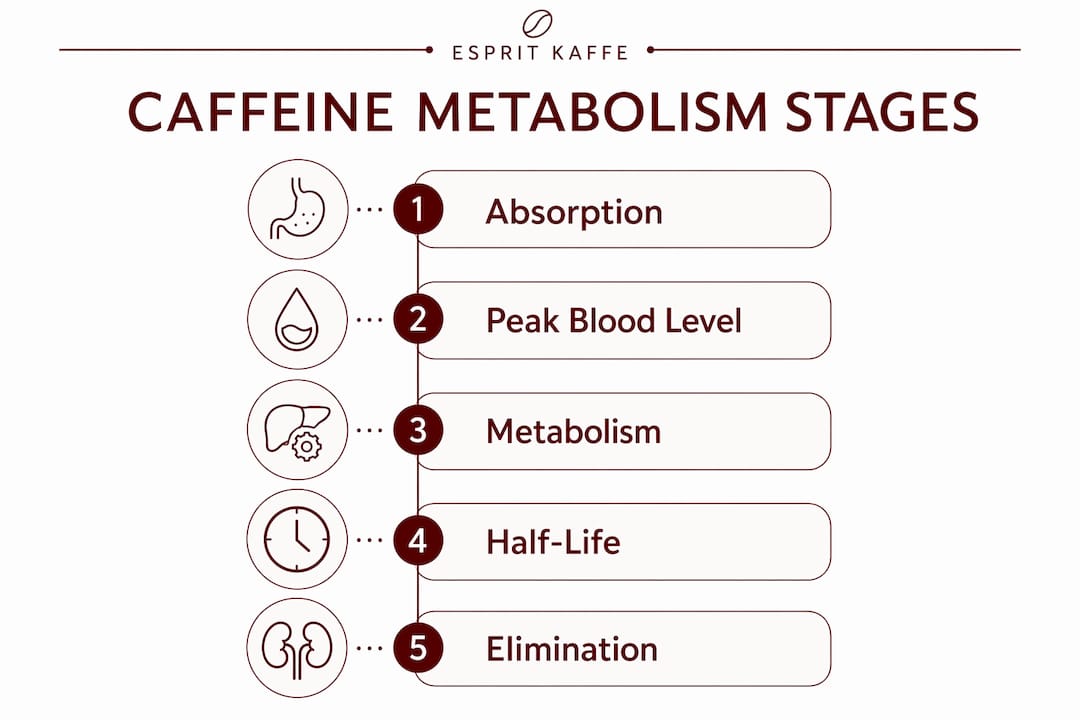
Caffeine reaches your bloodstream faster than most people expect. Stimulatory effects begin within 15 to 45 minutes of consumption, and peak blood levels arrive between 45 minutes and 1 hour after your last sip. That peak is when focus and alertness feel sharpest.
The stimulatory effects of caffeine duration typically spans 3 to 6 hours. After that window, most people feel the alertness fading. The problem is that caffeine itself has not cleared. With a 5-hour half-life, a 200mg dose consumed at 8:00 AM still leaves 100mg in your system at 1:00 PM and 50mg at 6:00 PM. You feel less alert, but the compound is still active.
This is where paraxanthine becomes important. Because it sustains physiological effects beyond the initial caffeine clearance, your body continues responding to caffeine chemistry even when the subjective buzz has faded. The perceived energy boost does not correlate well with how long caffeine remains metabolically active. Most people underestimate residual effects by several hours.
Here is a practical sequence for understanding caffeine’s timeline after a single 200mg dose:
- 0–15 minutes: Caffeine enters the bloodstream. Mild alertness begins.
- 15–45 minutes: Stimulatory effects ramp up noticeably. Focus sharpens.
- 45–60 minutes: Peak blood concentration. Alertness and energy are at their highest.
- 1–3 hours: Effects plateau, then begin to taper as caffeine is metabolized.
- 3–6 hours: Perceived alertness fades, but significant caffeine remains in the system.
- 6–10+ hours: Residual caffeine continues to affect sleep architecture, even without noticeable alertness.
Pro Tip: Tolerance reduces how alert caffeine makes you feel, but it does not shorten your half-life. If you have built up a tolerance, you may feel less wired but still carry the same residual caffeine load at bedtime.
Practical timing: when to stop drinking caffeine
The most direct application of caffeine half-life knowledge is setting a daily cutoff time. Research combining 24 studies recommends stopping caffeine at least 9 hours before bedtime to avoid sleep disruption. For a 10:00 PM bedtime, that means no caffeine after 1:00 PM. For a midnight bedtime, the cutoff shifts to 2:00–4:00 PM.
Sleep quality is the clearest casualty of poor caffeine timing. Caffeine impairs sleep architecture objectively even when people report feeling unaffected. You may fall asleep normally but spend less time in deep, restorative sleep stages. That deficit compounds over days and weeks, quietly eroding recovery and cognitive performance.
Knowing how to time caffeine for focus around your schedule makes a measurable difference. A few practical guidelines based on half-life math:
- Estimate residual caffeine: Divide your dose in half for every half-life that passes. A 300mg dose at noon leaves 75mg at 10:00 PM if your half-life is 5 hours.
- Adjust for your metabolism type: Fast metabolizers can push their cutoff slightly later. Slow metabolizers should move it earlier, sometimes by 2 or more hours.
- Account for medications: If you take a CYP1A2 inhibitor like fluvoxamine, your effective half-life may be 10 times longer than the population average.
- Watch for cumulative intake: Multiple cups across a day stack caffeine loads. The second cup adds to what the first has not yet cleared.
- Plan around your schedule: Scheduling caffeine around meetings and work blocks, rather than drinking reactively, gives you more control over both performance and sleep.
The table below shows estimated residual caffeine at bedtime based on dose and timing, assuming a 5-hour half-life:
| Caffeine dose | Time consumed | Residual at 10:00 PM |
|---|---|---|
| 200mg | 8:00 AM | Less than 10mg |
| 200mg | 12:00 PM | ~25mg |
| 200mg | 2:00 PM | ~50mg |
| 200mg | 4:00 PM | ~100mg |
| 300mg | 2:00 PM | ~75mg |
Key Takeaways
Caffeine half-life, governed by the CYP1A2 enzyme and individual genetics, determines how long caffeine stays active in your system and directly shapes your energy, alertness, and sleep quality.
| Point | Details |
|---|---|
| Half-life range | Healthy adults clear caffeine in 3–7 hours, depending on genetics and lifestyle. |
| CYP1A2 drives metabolism | This single liver enzyme handles over 90% of caffeine breakdown. |
| Paraxanthine extends effects | The primary metabolite sustains physiological activity after caffeine itself clears. |
| Timing cutoff matters | Stop caffeine at least 9 hours before bed to protect sleep architecture. |
| Tolerance does not change half-life | Habitual drinkers feel less alert but still carry the same residual caffeine load. |
Why I think most people are reading their caffeine wrong
Most people judge caffeine by how alert they feel. That is the wrong metric. After years of paying close attention to how caffeine actually behaves, the most consistent pattern I see is this: the moment you stop feeling wired is not the moment caffeine stops working. It is just the moment your adenosine receptors have adapted enough to mask the signal.
The biology is clear. Paraxanthine keeps driving physiological effects for hours after the subjective buzz fades. Sleep studies confirm that caffeine consumed in the afternoon degrades sleep quality even when people swear they slept fine. The body does not lie. The perception does.
What I find most useful is treating caffeine like a scheduled tool rather than a reactive habit. You would not take a medication at random times and expect consistent results. Caffeine deserves the same intentionality. Track your cutoff time for two weeks, hold it firmly, and pay attention to how your sleep depth and morning energy shift. The data you collect on yourself is more useful than any population average.
The other thing worth saying plainly: genetics matter more than willpower here. If you metabolize caffeine slowly, no amount of discipline changes your half-life. What changes is your awareness of it, and that awareness is where better decisions start.
— Jett
Espritkaffe: coffee built for how you actually metabolize it
Knowing your caffeine half-life is only useful if the coffee you drink gives you a consistent, predictable dose. Espritkaffe roasts every batch with that kind of intentionality in mind. Whether you want a morning cup that peaks fast or an afternoon option that keeps things measured, the coffee and tea collection gives you real choices across roast profiles and caffeine levels.
For those who want a smooth, lower-acidity option that fits a tighter timing window, the cold brew delivers a clean caffeine release without the spike. Espritkaffe is built for people who take their energy seriously, not just their taste.
FAQ
What is caffeine half-life?
Caffeine half-life is the time your body takes to reduce the caffeine concentration in your blood by half. In healthy adults, this typically ranges from 3 to 7 hours.
How long does caffeine stay in your system?
Caffeine can remain detectable in your system for up to 10 hours or more after consumption, depending on your metabolism speed, genetics, and any medications you take.
Does caffeine tolerance shorten its half-life?
Tolerance reduces how alert caffeine makes you feel, but it does not change how fast your body clears it. Habitual drinkers still carry the same residual caffeine load at bedtime.
What is the best time to stop drinking caffeine before bed?
Research from 24 combined studies recommends stopping caffeine at least 9 hours before bedtime. For a 10:00 PM bedtime, that means cutting off caffeine by 1:00 PM.
Can you speed up caffeine clearance by drinking water?
No. Hydration and dietary changes do not meaningfully accelerate caffeine metabolism. The clearance rate is controlled by liver enzyme activity and your genetic makeup, not fluid intake.