

Caffeine’s connection to dopamine is defined by a single neurochemical mechanism: caffeine blocks adenosine receptors in the brain, which removes a natural brake on dopamine signaling and produces the alertness, motivation, and mood lift you feel after your morning cup. This indirect relationship, known formally as adenosine receptor antagonism, is the foundation of every cognitive and emotional effect caffeine delivers. Understanding how caffeine influences dopamine at the receptor level, how timing and genetics shape that influence, and how tolerance erodes it over time gives you real control over your caffeine habits. Whether you are a student chasing focus, a professional managing energy across a long day, or a wellness enthusiast tracking mood, the caffeine and dopamine connection is the mechanism worth understanding first.
What is the caffeine and dopamine connection, exactly?
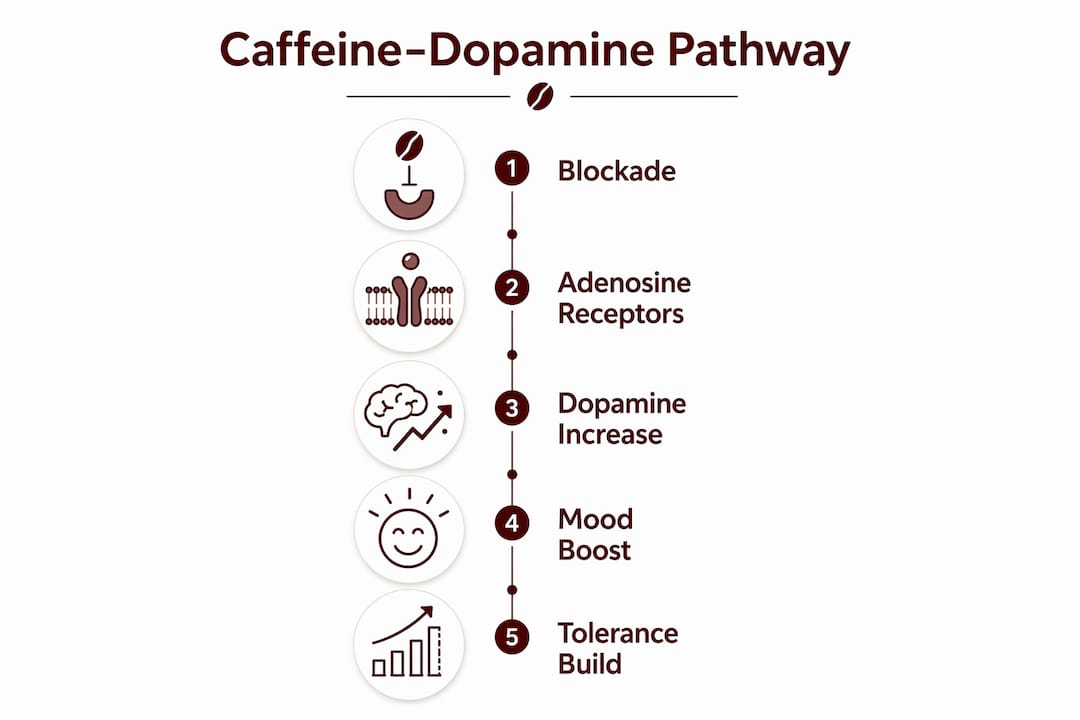
Caffeine does not release dopamine the way amphetamines or nicotine do. Instead, caffeine acts as an adenosine receptor antagonist, meaning it competes with adenosine for binding sites on A1 and A2A receptors throughout the central nervous system. Adenosine is a byproduct of neural activity that accumulates during waking hours and progressively suppresses dopamine signaling. When caffeine occupies those receptors, adenosine cannot bind, and the suppression lifts.
The result is increased dopamine neurotransmission in dopamine-rich brain regions, particularly the striatum and prefrontal cortex. These are the areas most responsible for motivation, reward processing, and executive function. Caffeine does not flood the brain with dopamine. It restores dopamine signaling to a higher baseline by removing adenosine’s inhibitory pressure.

This distinction matters. Caffeine’s mood and motivation effects are real, but they are modulating an existing system rather than hijacking it. That is why the effects feel like clarity and readiness rather than the sharp euphoria associated with direct dopamine agonists.
How caffeine influences dopamine at the receptor level
The molecular detail behind this process centers on a specific receptor partnership. A2A adenosine receptors and D2 dopamine receptors form what neuroscientists call a heteromer, a physical pairing on the surface of neurons in the striatum. When adenosine activates A2A receptors, it functionally suppresses D2 dopamine receptor signaling. Caffeine’s A2A receptor blockade breaks that suppression and allows dopamine to act more freely on D2 receptors, which drives motivational and arousal-related behaviors.
Key mechanisms at the receptor level include:
- A1 receptor blockade: Caffeine blocking A1 receptors increases the release of multiple neurotransmitters, including dopamine and norepinephrine, which together sharpen cortical arousal.
- A2A–D2 heteromer interaction: Caffeine’s blockade of A2A receptors directly enhances D2 receptor sensitivity, amplifying dopamine’s effect in motivation circuits.
- Downstream network effects: The dopamine-related mood changes from caffeine also involve glutamatergic and serotonergic networks activated downstream from adenosine blockade, not dopamine alone.
- EEG-confirmed arousal: Electroencephalogram studies confirm that caffeine’s cortical arousal signature aligns with adenosine antagonism and dopamine increases, providing measurable neurological evidence.
Pro Tip: If you want caffeine’s dopaminergic effects to work cleanly, avoid consuming it when adenosine levels are already low, such as immediately after waking. Waiting 60 to 90 minutes after rising lets adenosine accumulate enough for caffeine to produce a meaningful blockade.
Does caffeine timing change its effect on mood and dopamine?
Timing is not a minor variable. A 2025 study found that caffeine’s positive mood effects are significantly stronger in the morning, consistent with how circadian rhythms modulate both adenosine accumulation and dopamine system activity. The brain’s dopamine and noradrenaline systems follow a circadian pattern, and morning is when caffeine’s adenosine blockade aligns most favorably with those rhythms.
Nighttime caffeine intake tells a different story. Research shows that dopamine mediates caffeine-induced impulsivity, and this effect is more pronounced with evening or nighttime intake. Instead of producing focus and motivation, late caffeine can push dopamine activity toward impulsive decision-making and restlessness.
Here is a practical timing framework based on the current evidence:
- Wait 60 to 90 minutes after waking before your first cup. Cortisol peaks immediately after waking and partially covers adenosine’s alertness-suppression role. Caffeine is more effective once cortisol begins to drop.
- Target your primary caffeine window between 9:30 a.m. and 11:30 a.m. This is when adenosine has accumulated, cortisol is declining, and circadian dopamine rhythms are favorable for focus.
- Set a hard cutoff at 1:00 p.m. to 2:00 p.m. for most people. Caffeine has a half-life of roughly five to six hours. Afternoon intake extends into evening hours and disrupts sleep, which directly degrades dopamine receptor recovery overnight.
- Avoid caffeine entirely after 3:00 p.m. if you are sensitive to impulsivity effects or have noticed mood instability in the evenings.
For a deeper look at how this plays out across a workday, Espritkaffe’s guide on caffeine timing and focus breaks down the science with practical scheduling examples.
How genetics shape your personal caffeine-dopamine response
Not everyone processes caffeine the same way, and the reason is written into your DNA. Two genes in particular determine how strongly caffeine affects your dopamine-related behavior.
- ADORA2A gene variants: This gene encodes the A2A adenosine receptor. Variants in ADORA2A affect how sensitive your receptors are to caffeine’s blockade. People with certain ADORA2A variants report higher anxiety and inattention symptoms in response to caffeine, because their adenosine receptors are more reactive to disruption.
- DRD2 gene variants: This gene encodes the D2 dopamine receptor. Variants here affect how strongly your dopamine system responds once adenosine’s brake is lifted. Some DRD2 variants are associated with blunted dopamine signaling, meaning caffeine’s motivational boost is weaker for those individuals.
- Combined gene effects: When both ADORA2A and DRD2 variants are present, the behavioral outcomes from caffeine become harder to predict. Impulsivity, inattention, and anxiety responses all shift based on this genetic combination.
This is why two people can drink identical amounts of coffee and have completely different experiences. One person feels sharp and motivated. The other feels anxious and scattered. The caffeine dose is the same. The receptor landscape is not. If you consistently feel anxious or overstimulated after moderate caffeine intake, a genetic sensitivity in ADORA2A is a plausible explanation worth discussing with a healthcare provider.
What happens to dopamine effects when caffeine tolerance builds?
Tolerance is the mechanism that turns a performance tool into a maintenance requirement. With repeated daily caffeine use, the brain adapts by upregulating adenosine receptors, meaning it grows more receptors to compensate for the ones caffeine is blocking. As receptor density increases, caffeine needs to block more receptors to achieve the same dopaminergic effect. The same dose that once produced motivation and alertness now simply restores baseline function.
| State | Caffeine’s effect on dopamine |
|---|---|
| Caffeine-naive user | Significant dopamine signal increase above baseline, producing clear mood and motivation lift |
| Tolerant regular user | Dopamine signaling restored to normal baseline only; no net increase above pre-caffeine levels |
| Withdrawal state | Adenosine floods upregulated receptors, suppressing dopamine below normal and causing fatigue and low mood |
The withdrawal column explains why skipping your usual coffee feels so unpleasant. You are not experiencing a caffeine deficiency. You are experiencing adenosine overload on a receptor system that has been upregulated to expect caffeine’s blockade.
Pro Tip: A caffeine reset of five to seven days, where intake drops to zero or near zero, allows adenosine receptor density to normalize. After the reset, your original caffeine dose will produce dopaminergic effects closer to what a first-time user experiences. Plan the reset around a low-demand period, since the first two to three days involve real cognitive and mood costs.
If you want to manage your intake more deliberately around your schedule, Espritkaffe’s article on planning caffeine around meetings offers a practical framework for avoiding tolerance buildup while staying sharp when it counts.
Key takeaways
Caffeine boosts dopamine signaling indirectly by blocking adenosine receptors, and timing, genetics, and tolerance all determine how strong that effect actually is for you.
| Point | Details |
|---|---|
| Indirect dopamine mechanism | Caffeine blocks A1 and A2A adenosine receptors, removing suppression of dopamine signaling rather than releasing dopamine directly. |
| Morning timing maximizes benefits | Circadian rhythms make morning caffeine intake significantly more effective for mood and motivation than afternoon or evening use. |
| Genetics determine your response | ADORA2A and DRD2 gene variants explain why identical caffeine doses produce different behavioral outcomes across individuals. |
| Tolerance reduces dopaminergic gains | Chronic use upregulates adenosine receptors, reducing caffeine’s ability to boost dopamine above baseline over time. |
| Nighttime caffeine raises impulsivity | Dopamine-mediated impulsivity increases with evening caffeine intake, making late consumption counterproductive for focus-oriented goals. |
What I’ve learned from years of watching people misread caffeine
Most people treat caffeine as a simple on/off switch for energy. The neuroscience says it is closer to a volume dial on a system that is already playing. The mistake I see most often is chasing the feeling from the first cup of the week by drinking more on Thursday and Friday. That is not how adenosine receptor dynamics work. More caffeine on a tolerant system does not restore the original effect. It accelerates the adaptation and deepens the withdrawal trough.
The other misconception worth correcting is that caffeine “gives you dopamine.” It does not. Caffeine removes a suppressor of dopamine. That is a meaningful distinction because it means caffeine’s mood effects are bounded by your brain’s existing dopamine capacity. If your dopamine system is depleted from poor sleep, chronic stress, or nutritional gaps, caffeine cannot compensate. It can only lift what is already there.
Caffeine also exhibits neuroprotective and antioxidant effects in animal studies, suggesting its long-term relationship with brain health is more complex than simple receptor antagonism. That does not mean more is better. It means caffeine, used with timing and self-awareness, is a genuinely useful cognitive tool rather than just a habit.
The people I have seen use caffeine most effectively treat it like a precision instrument. They know their window, they respect their genetics, and they take planned breaks. They are not dependent on it. They are working with it.
— Jett
Espritkaffe: coffee matched to how your brain actually works

Understanding the caffeine and dopamine connection changes how you choose your coffee. At Espritkaffe, the range is built for people who think about what they are drinking and why. The dark roast collection delivers a rich, full-bodied caffeine experience suited for focused morning work sessions when adenosine blockade is most effective. The light roast options offer a gentler caffeine profile for those with ADORA2A sensitivity or anyone managing tolerance. For a different approach entirely, the mushroom coffee blend combines caffeine with adaptogenic mushrooms, designed for sustained clarity without the sharp dopaminergic spike that can tip into afternoon restlessness. Your order. Your roast. Your dopamine system.
FAQ
Does caffeine directly release dopamine?
Caffeine does not directly release dopamine. It blocks adenosine receptors, which removes inhibitory pressure on dopamine signaling and allows dopamine to act more freely in motivation and reward circuits.
Why does coffee feel stronger in the morning?
Morning caffeine intake aligns with circadian rhythms that favor dopamine and noradrenaline activity, making adenosine blockade more effective and producing stronger positive mood and alertness effects than afternoon or evening intake.
Can you build a tolerance to caffeine’s dopamine effects?
Yes. Chronic caffeine use triggers adenosine receptor upregulation, which reduces caffeine’s ability to enhance dopamine-related alertness and motivation. A five to seven day abstinence period allows receptor density to normalize and restores sensitivity.
Why does caffeine make some people anxious instead of focused?
Genetic variants in the ADORA2A gene make some individuals’ adenosine receptors more reactive to caffeine’s blockade, producing anxiety and inattention rather than calm focus. DRD2 variants further modify how the dopamine system responds once that blockade occurs.
Is nighttime caffeine bad for dopamine?
Nighttime caffeine intake increases dopamine-mediated impulsivity rather than focus or motivation, making it counterproductive for cognitive performance and potentially disruptive to the sleep-dependent recovery that dopamine receptors require.