

The Maillard reaction is the heat-driven chemistry between amino acids and reducing sugars inside a coffee bean, and it’s the main reason roasted coffee tastes toasted, nutty, and bready instead of grassy. It kicks off around 140°C to 150°C (284°F to 302°F) and stays active through most of the browning phase of a roast. For anyone roasting at home or just trying to taste with more intention, the takeaway is simple: this chemistry, not the color of the bean alone, is what roasters are actually steering when they adjust time, temperature, and airflow.
Key Takeaways
The Maillard reaction between amino acids and reducing sugars, active roughly between 140°C and 205°C, is the primary source of coffee’s roasted, nutty, and bready flavors.
| Point | Details |
|---|---|
| Core chemistry | Amino acids and reducing sugars combine and rearrange, eventually forming melanoidins and volatile aroma compounds. |
| Temperature window | Maillard activity runs roughly from 140°C to 150°C up through first crack near 196°C to 205°C. |
| Moisture matters | Water loss during drying has to finish first, since moisture slows the reaction’s early steps. |
| Roast level shifts flavor | Light roasts favor floral aldehydes; medium roasts favor pyrazines; dark roasts lean on melanoidins and pyrolysis. |
| Distinct from caramelization | Caramelization breaks down sugar alone; Maillard requires amino acids too, producing different flavor families. |
Table of Contents
- What Is the Maillard Reaction, Chemically Speaking?
- How Does the Maillard Reaction Unfold During Roasting?
- When Does Maillard Activity Peak in a Roast?
- Which Flavors Come From the Maillard Reaction?
- How Do Roasters Control Maillard Outcomes?
- Maillard Reaction vs. Caramelization: What’s the Difference?
- Is the Maillard Reaction in Coffee Safe to Drink?
- What Does Research Say About Bean Chemistry and Maillard Outcomes?
- How Espritkaffe Approaches Maillard Timing
- Frequently Asked Questions
- Sources
What Is the Maillard Reaction, Chemically Speaking?
Inside a green coffee bean, two groups of molecules are waiting for enough heat to react: amino acids (and small peptides) and reducing sugars like glucose and fructose. Trace lipids and chlorogenic acids ride along and shape the outcome too. Green-bean composition varies by variety and processing, which is why two beans roasted identically can still taste different.
The reaction itself moves through a short, well-mapped sequence: an amino acid and a sugar combine to form a glycosylamine, which rearranges into an Amadori compound, which then breaks down into hundreds of smaller aroma molecules and larger brown polymers called melanoidins.
- Amino acids and reducing sugars are the core reactants.
- Glycosylamine formation is the first committed step.
- Amadori rearrangement follows, opening the door to dozens of downstream pathways.
- Melanoidins give coffee its brown color, some bitterness, and body.
Pro Tip: If your roast seems slow to color up, check your drying phase. Water has to leave the bean before Maillard chemistry can get going, so a wet load or a low charge temperature delays browning even when your roaster’s display temperature looks high enough.
How Does the Maillard Reaction Unfold During Roasting?
Nothing about this is a single on-off switch. Once the bean dries out enough, Maillard chemistry runs as a continuous, overlapping cascade rather than one clean step, and it doesn’t happen in isolation. Strecker degradation, a related pathway where amino acids break down alongside Maillard intermediates, contributes fruity and floral aldehydes. Lipid oxidation adds its own volatile compounds on top of that.
Different branches of the cascade favor different compound families depending on exactly which amino acid met which sugar, and when. Pyrazines tend to build as the reaction matures, furans show up earlier and read sweeter, and aldehydes come and go depending on temperature swings. Roasters don’t have a direct readout of any of this, so they watch proxies instead: color shifting from tan to brown, and aroma moving from grainy to toasty to something closer to fresh bread.
Pro Tip: Smell your roaster’s exhaust, not just the beans. Aroma often shifts before color does, giving you a few seconds’ head start on adjusting heat.
When Does Maillard Activity Peak in a Roast?
The timeline runs in four rough stages: drying, browning (where Maillard dominates), first crack, and development. Moisture loss has to happen first. Water in the bean actively slows the early reaction steps, which is why nothing browns much until the bean is mostly dry.
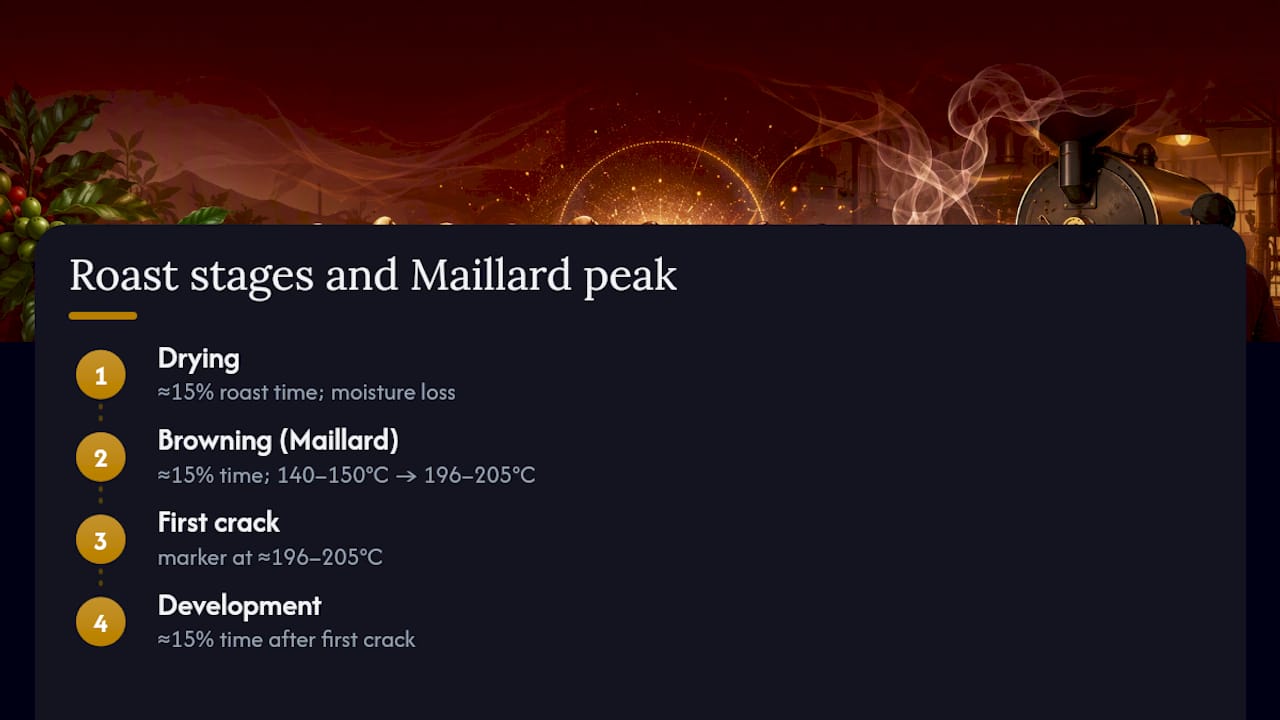
Maillard activity typically starts around 140°C to 150°C (284°F to 302°F) and stays dominant until close to first crack, roughly 196°C to 205°C (385°F to 401°F), where caramelization and the tail end of Maillard chemistry overlap.
You’ve probably heard of the 15-15-15 rule: roughly 15% of total roast time for drying, 15% for browning, and 15% for development after first crack, used as a rough proportional guide rather than a fixed formula. It’s a useful mental model, not a law. Bean density, batch size, and roaster type all bend those percentages, sometimes significantly.
Which Flavors Come From the Maillard Reaction?
Each compound family the Maillard cascade produces leaves a distinct fingerprint in the cup. Pyrazines read as roasted and nutty, furans lean sweet and caramel-like, aldehydes contribute fruity or floral top notes, and melanoidins build body along with some of the bitterness you taste in darker roasts.
- Pyrazines: roasted, nutty, sometimes cocoa-like.
- Furans: sweet, caramelized, occasionally toasted-sugar.
- Aldehydes: fruity, floral, sometimes green when underdeveloped.
- Melanoidins: body, mouthfeel, and a baseline bitterness.
Roast level shifts the balance dramatically. A light roast stops the cascade earlier, leaving more floral aldehyde character and less melanoidin bitterness. A medium roast lets pyrazines build fully, which is where you get that classic bready, nutty profile. Push into dark roast territory and melanoidins and pyrolysis products start to dominate, flattening some of the more delicate Maillard notes underneath heavier, smokier ones. If you want to taste this directly, our guide to coffee roast levels breaks down what to expect cup by cup.
Pro Tip: Brew the same coffee at two roast levels side by side. Taste for the shift from floral and fruity in the lighter cup to nutty and bready in the darker one. This is the Maillard balance moving in real time.
How Do Roasters Control Maillard Outcomes?
Roasters lean on a handful of practical levers: charge temperature, rate of rise through the browning phase, airflow, drum speed versus fluid-bed movement, and development time after first crack. Slowing the rate of rise through Maillard temperatures tends to build rounder sweetness and clearer bready notes. Pushing through that same window faster tends to sharpen pyrazine-driven roastiness, sometimes at the cost of complexity.
Color meters (Agtron readings), aroma shifts, bean surface sheen, and the timing and duration of first crack all serve as monitoring checkpoints along the way. None of them measure Maillard chemistry directly, but together they give a reliable read on how far the cascade has progressed.
Equipment matters more than most home roasters expect. The same time and temperature curve run on a drum roaster versus a fluid-bed roaster can produce different Maillard results, because heat transfer and bean agitation aren’t equivalent. Anyone experimenting with different setups will notice this firsthand, and it’s part of why our fire roast coffee guide treats method as its own variable, separate from temperature alone.
Maillard Reaction vs. Caramelization: What’s the Difference?
These two get lumped together constantly, but they’re separate chemical processes with separate ingredients.
- Maillard reaction: amino acids plus reducing sugars, producing melanoidins and hundreds of aroma volatiles.
- Caramelization: sugar breaking down on its own with no amino acids involved, typically becoming significant above roughly 170°C.
- Pyrolysis: pure thermal breakdown or charring, dominant only at the highest roast temperatures and responsible for ashy, burnt notes.
Maillard tends to read as nutty and bready. Caramelization leans sweet and toasty. Pyrolysis, when it shows up, tastes flatly burnt, and it’s usually a sign the roast pushed too far.
Is the Maillard Reaction in Coffee Safe to Drink?
The Maillard reaction itself isn’t a safety issue. It’s the same chemistry that browns bread crust and seared meat, and it’s been part of human cooking for as long as we’ve applied heat to food. The concern people actually mean to ask about is acrylamide, a compound that can form as a side reaction during high-heat cooking, including coffee roasting.
Acrylamide levels in roasted coffee are measurable, but regulatory agencies monitor and set exposure guidance for it, and typical coffee consumption falls within the ranges public-health bodies consider low-risk. If you have specific exposure concerns, particularly around cumulative dietary intake, consumer-safety resources and public-health guidance are the right place to check, not roast-level speculation.
What Does Research Say About Bean Chemistry and Maillard Outcomes?
Recent food-chemistry reviews tie the amount of precursor sugars and amino acids in arabica beans directly to which Maillard products form and how the finished beverage tastes. Origin, variety, and processing method (washed versus natural, for instance) all shift that precursor balance before the bean ever reaches a roaster.
Precursor composition, specifically sugar and amino acid profile, is a key influencing factor in which Maillard products actually form and, by extension, in the resulting flavor and quality of the brewed coffee.
For roasters and curious drinkers alike, the practical move is picking beans with intention. A natural-processed lot often carries more residual sugar into the roast, which can shift Maillard products toward sweeter, fruitier outcomes than a washed lot of the same variety.
How Espritkaffe Approaches Maillard Timing
We treat the browning phase as the part of the roast that decides most of the flavor, not an afterthought before first crack. That means managing rate of rise carefully through Maillard temperatures rather than rushing past them, and favoring controlled development after first crack for clarity over intensity. It’s a deliberate choice, not a default setting.
Tasting roast levels side by side is the fastest way to feel this chemistry rather than just read about it. Our instant coffee lineup makes that comparison easy without committing to a full bag, and if you want something with a different flavor angle, the instant coffee with mushroom version is worth trying too.
Frequently Asked Questions
What is the Maillard reaction in coffee, in one sentence? It’s the heat-driven reaction between amino acids and reducing sugars in a coffee bean that produces browning, roasted aroma compounds, and much of what you taste as “roasted” flavor.
At what temperature does the Maillard reaction start in coffee roasting? Most roasters see it begin around 140°C to 150°C (284°F to 302°F), once the bean has dried out enough for the reaction to proceed.
Does the Maillard reaction cause coffee to taste bitter? Some bitterness comes from melanoidins formed during Maillard chemistry, but heavy bitterness usually signals the roast pushed into caramelization or pyrolysis territory beyond typical Maillard temperatures.
Is Maillard reaction coffee safe to drink? Yes. The reaction itself is the same browning chemistry found in bread and seared meat; the only related safety topic worth monitoring is acrylamide, which regulatory agencies track and address through public exposure guidance.
How does roast level affect Maillard flavor outcomes? Light roasts stop the cascade earlier and keep more floral, fruity notes; medium roasts let pyrazines fully develop for nutty and bready flavor; dark roasts push past most Maillard character into heavier, smokier notes.
Sources
- The Maillard Reaction
- What Is the Maillard Reaction in Coffee Roasting?
- Insights into flavor and key influencing factors of Maillard reaction products: A recent update
- Food Chemistry – The Maillard Reaction | Compound Interest
- Maillard reaction | chemistry | Britannica