

There’s no separate “espresso bean” species. What you’re buying is a roast and grind decision, not a different plant. The differences that actually hit your cup come down to three things:
- Roast direction: espresso-labeled beans usually land Full City to French roast.
- Grind size: roughly 200 to 400 microns for espresso, much coarser for drip.
- Extraction: about 9 bars of pressure pushing water through in 25 to 30 seconds.
Understand those three levers, and the espresso beans vs coffee question stops being confusing.
Key Takeaways
Roast profile and grind size, not bean species, are what separate espresso from regular drip coffee.
| Point | Details |
|---|---|
| No separate species | “Espresso bean” describes a roast and grind intent, not a different plant or origin. |
| Roast range matters | Espresso beans typically sit Full City to French, while filter roasts stay lighter for acidity. |
| Grind and pressure are the mechanics | Espresso needs 200 to 400 microns and about 9 bars; drip needs 600 to 1,200 microns. |
| Freshness affects crema | Rest dark roasts 24 to 72 hours after roasting, and use beans within two weeks for peak flavor. |
| Match roast to your machine | Esprit Kaffe roasts dark blends for pressure brewing and lighter roasts for filter methods. |
Table of Contents
- Espresso Beans vs Coffee: What “Espresso” on the Bag Actually Means
- How Roast Level Changes Flavor and Body
- What Grind Size and Pressure Do to Extraction
- Can You Use Espresso Beans for Drip or Regular Beans for Espresso?
- How Do You Choose Beans for Your Machine?
- Storage and Freshness: How Long Do Beans Really Last?
- Where Did “Espresso Bean” Even Come From?
- Does Arabica vs Robusta Matter More Than Roast?
- How Roasting Changes the Chemistry Behind the Flavor
- The Biggest Misconceptions About Espresso Beans
- Esprit Kaffe’s Roaster Notes on Building Espresso and Filter Profiles
- Ready to Try a Roast Built for Your Brew Method?
- Sources
Espresso Beans vs Coffee: What “Espresso” on the Bag Actually Means
When a roaster prints “espresso” on a bag, they’re telling you how they roasted it and who they expect to buy it, not naming a different kind of coffee. There is no botanical “espresso bean.” Any coffee bean can be roasted and brewed as espresso — the label is roaster intent, aimed at a specific grind and pressure target.
Blends dominate the espresso shelf for a practical reason. Roasters combine origins to hit consistency, body, and sweetness that survive extraction under pressure, and that same balance holds up when you dump milk on top of it. A blend built for espresso rarely tastes thin in a latte.
Single-origin espresso exists too, and some roasters love pulling it. You get brighter, more distinct flavor from one farm or region, but it demands tighter dial-in and can taste sharp or sour if your grind and dose aren’t precise. It’s a trade: character for forgiveness.
- Blends: built for consistency and milk compatibility.
- Single-origin espresso: more character, less margin for error.
- Either way, the roast profile matters more than the origin label.
How Roast Level Changes Flavor and Body
Roast level is where the real difference between an “espresso” bag and a “filter” bag shows up. Beans destined for espresso typically sit in the Full City to French range, corresponding to an Agtron reading around 35 to 50, well into the darker end of the roast spectrum. Filter and drip roasts usually stay lighter, often City to Full City, to preserve acidity and origin character.
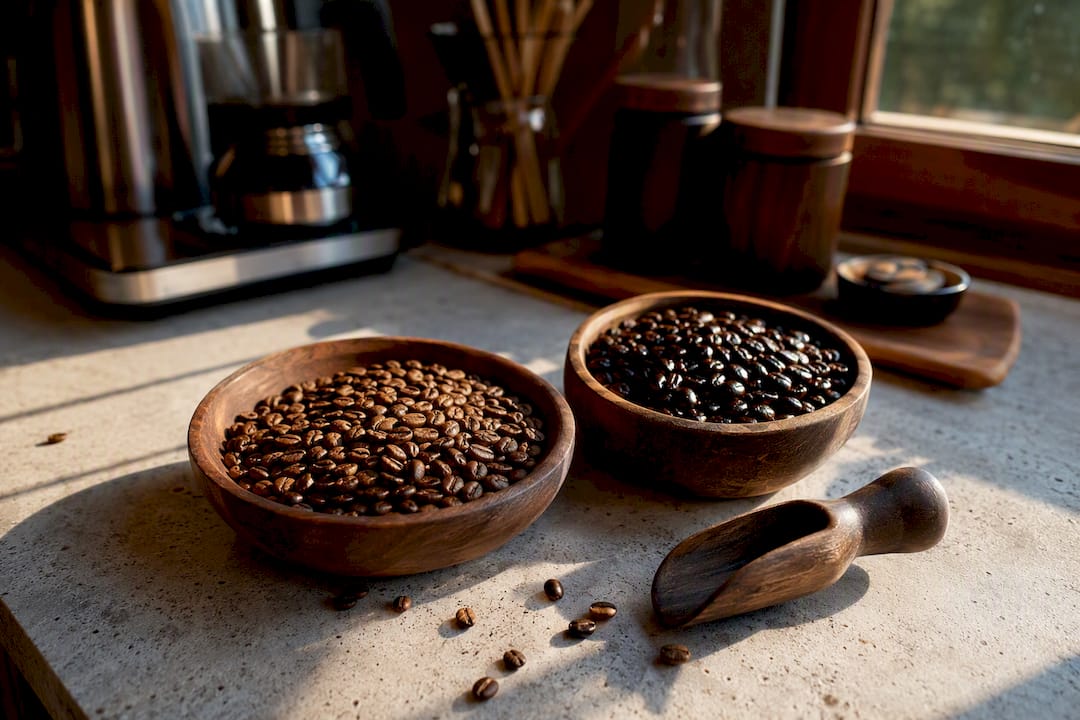
Roast development physically changes the bean. Longer, hotter roasting breaks down chlorogenic acids, which is why darker roasts taste less sour and more bitter or bold. It also pushes oils to the surface, giving you that visible sheen on dark roast beans and adding body to the cup. That extra body matters for espresso specifically because it holds up crema and cuts through milk.
Pull the same bean as drip coffee versus espresso and you’ll notice: darker roasts in a drip cone can taste flat or ashy, while lighter roasts pulled as espresso often taste sour or thin unless your grind is dialed in tight. Neither is wrong. They’re just built for different extraction conditions. If you want a deeper breakdown of how each stage changes flavor, our roast level guide walks through the whole spectrum.
What Grind Size and Pressure Do to Extraction
Grind size is the mechanical reason espresso and drip coffee behave so differently, even from identical beans. Espresso needs a grind fine enough to build resistance: roughly 200 to 400 microns, packed into a puck that water has to fight its way through. Drip and French press use a much coarser grind, closer to 600 to 1,200 microns, because gravity or a slow steep does the extracting instead of pressure.
That resistance matters because espresso machines force water through the puck at around 9 bars, extracting a shot in 25 to 30 seconds. Get the grind wrong and the whole shot falls apart:
- Too coarse for espresso: water rushes through in under 20 seconds, tastes sour and weak. That’s under-extraction.
- Too fine for espresso: shot chokes, drips slowly or stalls, tastes bitter and harsh. That’s over-extraction.
- Espresso grind used in a drip machine: slow, muddy, over-extracted coffee and a mess in your filter.
Pro Tip: Never run an espresso grind through a drip machine “just to see.” The fines clog paper filters and pull out harsh, bitter compounds that a coarser grind would never touch.
Our grind chart maps micron ranges to dial settings if you’re troubleshooting a specific grinder.
Can You Use Espresso Beans for Drip or Regular Beans for Espresso?
Yes, on both counts, with some adjustment. Espresso is an intent you can apply to almost any bean if you can control grind, dose, and temperature.
- Espresso roast in a drip machine: grind coarser than you would for espresso, and expect a heavier, less bright cup than a dedicated filter roast would give you. It works fine for a bold morning pot.
- Filter roast pulled as espresso: grind fine, dose carefully, and expect to fight more acidity. A stable-temperature machine and a burr grinder that can hit a narrow micron range make this realistic; a basic pump machine usually can’t.
- Skip it when: you’ve got a very oily dark roast and a bean-to-cup or super-automatic machine. Those oils gum up internal grinders and brew groups over time.
How Do You Choose Beans for Your Machine?
Match the roast to what your equipment can actually pull off, not just what sounds appealing on the shelf.
- Bean-to-cup and super-automatic machines: stick to medium to medium-dark roasts. Skip heavily oily dark roasts to protect the internal grinder.
- Entry-level espresso machines: a solid espresso blend, medium-dark, is the most forgiving place to start while you learn to dial in.
- Prosumer machines with PID temperature control: you’ve got the headroom to experiment with single-origin espresso or lighter roasts.
- Pour-over, French press, and drip: go lighter, City to Full City, and let the origin character do the talking.
Blends still win for anyone who wants the same cup every morning without babysitting the grinder. Single-origin makes more sense if you enjoy tweaking and want to taste one farm’s personality. Before buying, check three things on the bag: the roaster’s recommended brew method, the roast date, and any tasting notes that hint at acidity or body. A bag with no roast date is a red flag no matter how good the label looks.
Storage and Freshness: How Long Do Beans Really Last?
Fresh-roasted beans release CO2 for days after roasting, and darker roasts sometimes need 24 to 72 hours of rest before they pull a good crema. Pulling shots the same day they were roasted often gives you a wild, unpredictable extraction.
- Keep beans sealed in the original valve bag or an opaque, airtight container.
- Keep them away from heat, light, and moisture. Never store beans in the fridge.
- Use within two weeks of the roast date for peak flavor; beans stay drinkable longer, just flatter.
Where Did “Espresso Bean” Even Come From?
The phrase “espresso bean” is younger than most people assume, and it’s a marketing convenience more than a technical term. Espresso the brewing method dates to Italy in the early 1900s, built around machines that forced hot water through packed grounds under pressure to make coffee fast for standing customers at a bar. For decades, Italian roasters didn’t sell “espresso beans” as a distinct product category. They roasted coffee dark, in blends built for consistency, because that’s what their machines and customers demanded. The beans were just coffee, roasted for a specific job.
The retail label “espresso beans” caught on as home espresso machines spread outside Italy, especially through the specialty coffee boom of the 1980s and 1990s. Roasters and grocery stores needed a fast way to signal “this bag is roasted dark and blended for pressure brewing” to shoppers who didn’t know roast terminology. “Coffee beans,” meanwhile, became the default catch-all for everything else, usually lighter roasts intended for drip machines.
That labeling shortcut stuck, and it’s why so many people now assume espresso comes from a different plant or growing region entirely. It doesn’t. The split is entirely about what happened after harvest: how the beans were roasted, and what grind and brewing pressure the roaster had in mind when they bagged them. Understanding that history clears up most of the confusion baked into the espresso beans vs coffee debate.
Does Arabica vs Robusta Matter More Than Roast?
Bean variety plays a role, but it’s a smaller factor than most shoppers assume compared to roast and grind. Arabica dominates specialty coffee, prized for smoother acidity, more complex aromatics, and lower caffeine content. Robusta, grown at lower altitudes and more resistant to pests, tends to taste harsher and more bitter on its own, but it carries more caffeine and produces a thicker, more persistent crema.
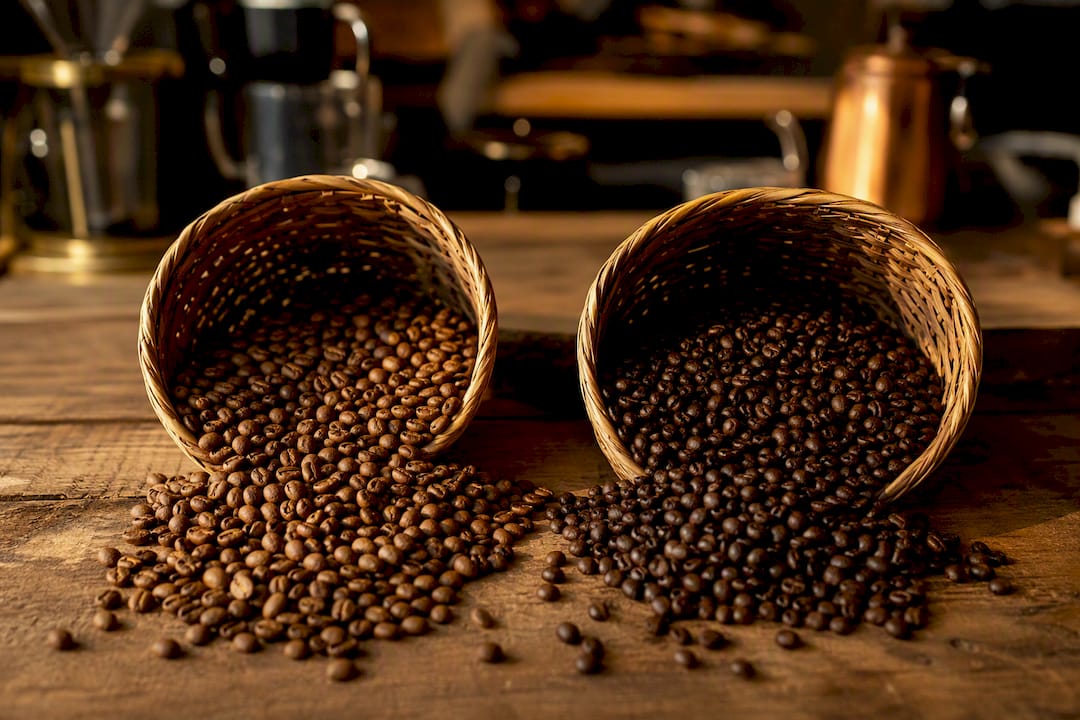
That crema advantage is exactly why Robusta shows up in many traditional Italian espresso blends, often at 10 to 30 percent alongside Arabica. It’s not there because Robusta tastes better solo. It’s there because it adds body and foam stability that pure Arabica sometimes lacks, especially in commercial blends designed to survive a busy bar shift. Specialty roasters chasing brighter, more nuanced espresso often skip Robusta entirely and rely on high-quality Arabica plus a darker roast to build body instead.
For drip and filter coffee, Robusta is far less common. Filter brewing showcases acidity and aromatic complexity, exactly where Arabica shines and Robusta tends to taste flat or rubbery. You’ll find Robusta mostly in budget commercial blends and instant coffee, where cost and caffeine content matter more than nuance.
So when you’re comparing espresso beans vs coffee, variety matters, but it’s roast and blend composition doing most of the heavy lifting. A well-roasted Arabica blend built for pressure will usually beat a poorly roasted mix of “premium” beans every time.
How Roasting Changes the Chemistry Behind the Flavor
Roasting is a controlled chemical reaction, and how far you push it determines almost everything about how a bean tastes brewed one way versus another. Green coffee is dense, grassy, and nearly flavorless. Heat triggers the Maillard reaction almost immediately, the same browning reaction that gives seared meat and toasted bread their flavor, building sugars and amino acids into hundreds of new aromatic compounds.
Push the roast further into caramelization, and sugars break down further, adding sweetness alongside darker, more roasted notes. Keep pushing past Full City into French roast territory, and you start breaking down chlorogenic acids almost entirely, which is why dark roasts taste far less acidic than light ones. That same heat pulls oils to the bean’s surface, which is what gives dark roast espresso beans their characteristic sheen and adds to the body you feel in a shot.
Lighter roasts stop this process earlier, preserving more of the bean’s original acids and volatile aromatics, which is why a light roast Ethiopian can taste like blueberries or citrus while a French roast from the same lot tastes like dark chocolate and smoke. Neither profile is more “correct.” They’re just different points on the same chemical timeline, and espresso roasting simply pushes that timeline further to build the body and reduced acidity that hold up under pressure and milk.
The Biggest Misconceptions About Espresso Beans
The most persistent myth is that espresso beans come from a different plant or region than regular coffee. They don’t. Any bean, light or dark, Arabica or Robusta, can be ground fine and pulled through 9 bars of pressure.
A close second: darker automatically means stronger. Roast level changes flavor, body, and bitterness, but it doesn’t add caffeine. In fact, longer roasting burns off a small amount of caffeine, so a light roast typically has slightly more caffeine by volume than a dark roast of the same bean.
People also assume “espresso roast” only works in an espresso machine. It’s a fine coffee for a French press or moka pot if you enjoy a bolder, lower-acid cup. And plenty of home baristas think buying pre-ground “espresso” grounds guarantees a good shot. Grind degrades fast once exposed to air, so pre-ground espresso coffee is often stale and mis-sized for your specific machine long before it reaches your portafilter.
Esprit Kaffe’s Roaster Notes on Building Espresso and Filter Profiles
At Esprit Kaffe, we roast by intent, the same principle running through this entire comparison. A bean headed for espresso gets pushed further to build body and tame acidity; a bean headed for pour-over gets pulled earlier to keep its brighter character intact. Neither approach is better. They’re built for different machines and different mornings.
Our dark roast options are built with pressure brewing in mind, developed for drinkers who want body and low acidity in a shot glass. Our lighter roasts are meant for filter methods, where subtlety matters more than punch. Whichever you pick, match your grinder to the roast: a fine, consistent grind for espresso, coarser for drip. The roast gets you halfway there. Your equipment finishes the job.
— Jett
Ready to Try a Roast Built for Your Brew Method?
Picking between espresso beans vs coffee comes down to matching a roast to your machine, and Esprit Kaffe roasts specifically with that in mind. If you’re pulling shots at home, our Coffee with Mushrooms Dark Roast is built for pressure brewing: full body, low acidity, and enough structure to stand up to milk.
Every bag ships with a roast date printed on it, so you always know how fresh you’re pulling from, and you can choose whole bean or a grind matched to your machine at checkout. If espresso isn’t your daily habit, our Instant Coffee covers the convenience side without asking you to own a grinder at all. Whichever you pick, remember the grind has to match the brew method: fine for espresso, coarse for drip. Order a bag, check the roast date when it lands, and dial in from there.
Sources
For deeper technical detail on roast ranges and grind targets, see Mahlkönig’s guide to espresso versus filter beans and their grind size settings breakdown. For brewing method comparisons beyond espresso, Wine Drop Cookery’s pour-over versus drip guide is a useful companion read.
- Espresso vs filter coffee beans — Mahlkönig (news)
- Espresso beans vs coffee beans explained — CoffeeRoast Co.