

Morning ambiance matters because it sets a biological and emotional anchor for your entire day, and three moves you can make right now will shift it: step outside or near a bright window for 10 minutes, clear one surface in the room where you wake up, and leave your phone face-down for the first 15–20 minutes. That’s it. The science behind why those three things work is worth understanding, because once you see the mechanism, you’ll stop treating your morning environment as an afterthought.
- Get natural light within 30 minutes of waking. Your suprachiasmatic nucleus (SCN), the brain’s master clock, needs a strong light signal to reset your circadian rhythm and time your cortisol awakening response (CAR) correctly.
- Clear one surface. Visual clutter is processed as unresolved tasks. One cleared counter or nightstand reduces decision friction before your prefrontal cortex is fully online.
- Delay your phone. Notifications are emotional anchors too. The first input of the day biases how you interpret everything that follows. Make it yours, not someone else’s.
Espritkaffe was built around exactly this idea: that the first deliberate moment of the day, a quiet cup, a clear space, a breath before the noise, changes what comes after.
Table of Contents
- Why morning ambiance shapes your biology and mood
- Three core design pillars that make mornings work
- A sensory checklist for your morning environment
- How to design short morning rituals and pick your spot
- How quickly you’ll notice results, and what it costs
- Three habits that keep your mornings working
- Key Takeaways
- The part of morning ambiance most people overlook
- A morning ritual worth building around
- Useful sources for further reading
Why morning ambiance shapes your biology and mood
The cortisol awakening response is the body’s built-in alarm system. Cortisol levels typically rise significantly within the first 30–60 minutes after waking, preparing your immune system, metabolism, and attention for the demands ahead. What most people don’t realize is that the environment you wake into directly influences whether that response is calibrated or dysregulated. A chaotic, cluttered, loud space spikes cortisol in the wrong direction. A calm, ordered one lets it peak and taper naturally.
Light is the strongest lever. Natural morning light can be 10,000–100,000 lux while typical indoor lighting ranges from about 100–300 lux. That gap matters because the SCN requires a strong photon signal to anchor your circadian rhythm to the actual time of day. Even 10–20 minutes of outdoor exposure, without sunglasses, is enough to produce reliable circadian effects. On overcast days or in winter, a quality light therapy lamp placed at eye level can partially substitute.
Cortisol rises 50–100% in the first 30–60 minutes after waking. The environment you’re in during that window shapes whether that surge works for you or against you.
For artificial lighting, design experts recommend warm bulbs in the 2200K–3000K range and placing light sources below eye level to support melatonin timing and create psychological safety. Overhead fluorescents at 5000K+ first thing in the morning push your nervous system toward alertness before it’s ready.
The psychological mechanism is equally concrete. Research on anchoring and mood-congruent cognition shows that the first emotional state of the day biases memory retrieval and appraisal for hours afterward. Walk into a messy kitchen and feel mild irritation at 6:45 AM, and you’re more likely to interpret an ambiguous email at 9 AM as hostile. The first input sets the interpretive frame.
| Mechanism | What it does | Morning implication |
|---|---|---|
| Cortisol awakening response (CAR) | Prepares body for daily demands | Peaks 30–60 min after waking; environment shapes its quality |
| SCN circadian reset | Anchors body clock to time of day | Needs strong light signal within first hour |
| Prefrontal cortex warm-up | Enables executive function | Takes 20–30 min to reach full capacity after waking |
| Anchoring effect | First emotion biases daily perception | Positive first input improves downstream appraisal |
Three core design pillars that make mornings work
Architectural and design experts consistently point to three pillars for morning readiness: light, storage, and flow. These aren’t aesthetic categories. They’re the three places where micro-stressors pile up in the first 20 minutes and quietly drain your energy before the day starts.
Light is the most impactful and often the most neglected. Before: heavy curtains stay closed because no one wants to deal with them at 6 AM. After: a simple sheer panel layered behind a blackout curtain lets you pull one cord and flood the room with daylight. That single change delivers a circadian signal and a mood lift simultaneously. For fixture placement and bulb selection, a warm LED in the 2700K range on a bedside lamp beats an overhead fixture every time in the first 30 minutes.

Storage is about removing decisions. Before: you spend four minutes hunting for your phone charger, your keys, and a clean mug. After: a small tray on the counter holds the three things you touch every morning. Clearing a single surface reduces visual noise and decision friction at exactly the moment your prefrontal cortex is least equipped to handle it.
Flow means the physical path from bed to coffee to door has no unnecessary friction. Before: you navigate around a laundry basket, a chair piled with clothes, and a closed bathroom door. After: the path is clear, the bathroom door stays open, and the coffee setup is within arm’s reach of the sink. Small, but the cumulative effect on perceived ease is significant.
Pro Tip: If you only have 30 minutes and $0 to spend, fix storage first. Clearing one surface costs nothing and delivers an immediate reduction in cognitive load. Light and flow improvements can follow.
A sensory checklist for your morning environment
Your senses process the environment before your conscious mind does. Here’s how to manage each one deliberately.
Sight
- Open curtains or blinds immediately upon waking, before checking your phone.
- If natural light is limited, use a bedside lamp with a warm bulb (2200K–3000K) on a timer set 5 minutes before your alarm.
- Keep the first surface you see uncluttered: nightstand, dresser top, or kitchen counter.
Sound Your first sound after waking strongly influences emotional tone. News and notifications are the worst possible opener. Choose one of three options: silence, a soft curated playlist (ambient or acoustic, nothing with lyrics that demand attention), or a gentle timer tone. Set this up the night before so it’s automatic.
Smell Citrus scents, light coffee aroma, or a mild herbal candle can shift alertness without overwhelming the nervous system. Avoid heavy synthetic fragrances first thing. The smell of fresh coffee brewing is genuinely effective, partly because of the aroma itself and partly because it signals that a pleasant ritual is coming. No-cost option: open a window for two minutes.
Touch and temperature The first physical sensation of the day matters more than most people expect. A soft robe or linen you actually like reaching for, a glass of room-temperature water before anything else, and a thermostat set to 65–68°F for morning alertness all contribute. Cold hands and a stiff neck from poor bedding are micro-stressors that compound.

Pro Tip: The no-cost moves here (opening curtains, choosing silence, drinking water first) deliver most of the benefit. Save purchases for after you’ve tested the free version.
How to design short morning rituals and pick your spot
A supportive 20‑minute morning environment can set the tone for up to 80% of your perceived daily energy and momentum. The key is matching the routine to the time you actually have, not the time you wish you had.
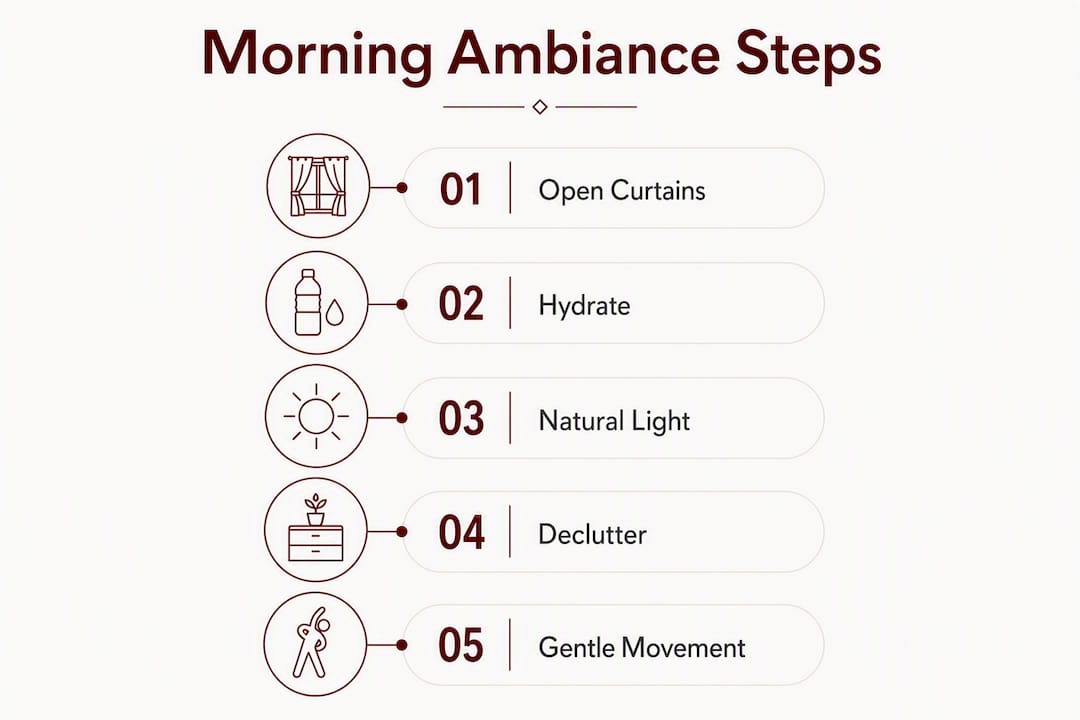
5–10 minute template Open curtains (1 min), drink a glass of water (1 min), sit in natural light for 5 minutes without a screen, make your bed or clear one surface (2 min). That’s it. Enough to trigger the CAR correctly and set a calm anchor.
15–20 minute template Add light movement (stretching or a short walk outside) for 5 minutes, then a deliberate drink, coffee or tea, taken sitting down rather than standing over the sink. No phone until the cup is finished.
30–45 minute template Include 3–5 minutes of journaling before consuming any content. Write one sentence about what you want the day to feel like. Then light, movement, drink, and 10 minutes of reading something you chose, not something that arrived in a notification.
Choosing your morning spot
Experts recommend a dedicated nook or chair that removes productivity pressure and lets the brain ease into the day. When selecting yours, check for:
- Visibility to natural light (window within sightline, not necessarily direct sun)
- Low clutter in the immediate field of view
- Comfortable seating you don’t have to adjust
- Proximity to water or your coffee setup
A small tray, a plant, and a mug you like are enough to make a corner feel intentional. The purpose of a designated coffee corner goes beyond aesthetics: it creates a spatial cue that tells your brain “this is the calm part.”
Pro Tip: Habit stacking works here. After you pour your morning water, sit in your chosen spot for 3 minutes of light exposure before doing anything else. Attaching the new behavior to an existing one removes the need for willpower.
How quickly you’ll notice results, and what it costs
Timeline expectations matter. Most people abandon morning routines because they expect a dramatic shift in week one and get a subtle one instead.
- Days 1–3: Mood on waking feels slightly less abrupt. The cleared surface and light exposure reduce the sense of being immediately behind.
- Weeks 1–3: Sleep onset time often improves as circadian signaling stabilizes. Morning energy feels more consistent rather than dependent on caffeine.
- Months 1–3: The routine becomes automatic. The morning space starts to feel like a genuine anchor rather than a project.
| Action | Expected time to notice | Approximate cost |
|---|---|---|
| Open curtains, delay phone | 1–3 days | $0 |
| Clear one surface | 1–3 days | $0 |
| Warm bulb swap (2700K LED) | 1 week | $15 |
| Bedside lamp on timer | 1–2 weeks | $20 |
| Dedicated morning chair or tray | 2–3 weeks | $30–$100 |
| Light therapy lamp (winter) | 1–3 weeks | $80 |
The $0 moves deliver most of the benefit. The paid upgrades extend and reinforce what the free habits establish. There’s no version of this that requires a renovation.
Three habits that keep your mornings working
One-time setup fades without maintenance. These three habits take under five minutes each and protect the gains.
- Clear one surface each evening. The kitchen counter or nightstand you cleared this morning will drift back toward clutter by 9 PM. A 90-second reset before bed means you wake to the same calm environment tomorrow.
- Set your light before you sleep. Open the curtain a crack, or set your bedside lamp timer. The morning version of you will not want to make decisions. Remove the decision the night before.
- Hold the 15-minute phone delay. This one erodes fastest under pressure. Keep the phone charger outside the bedroom if that’s what it takes.
Weekly micro-maintenance (under 10 minutes total)
- Monday: Wipe down the morning spot surface and refill any supplies (coffee, candles, water bottle).
- Wednesday: Reassess the sound environment. Is the playlist still working, or has it become background noise you tune out?
- Sunday: Spend 5 minutes adjusting anything that drifted: a lamp position, a cluttered tray, a curtain that stopped opening smoothly.
To measure progress, keep it simple. Rate your morning energy on a 1–5 scale in a notes app for two weeks. Note sleep onset time if you track it. You’re looking for trend, not perfection. Most people see a clear pattern within 10 days.
Key Takeaways
Morning ambiance matters because the first 20 minutes after waking set a biological and emotional anchor that shapes mood, energy, and perception for the rest of the day.
| Point | Details |
|---|---|
| The 20-minute window is decisive | Light, sound, and clutter in the first 20 minutes after waking calibrate your cortisol response and emotional anchor. |
| Three pillars to audit first | Light, storage, and flow are the design categories where morning micro-stressors concentrate. |
| Free moves deliver most of the benefit | Opening curtains, clearing one surface, and delaying phone use cost nothing and work within days. |
| Warm light at the right temperature | Bulbs in the 2200K–3000K range placed below eye level support melatonin timing and psychological calm. |
| Espritkaffe as a morning anchor | A deliberate coffee ritual, a designated corner, and a quality cup reinforce the calm the environment creates. |
The part of morning ambiance most people overlook
Here’s the thing about morning environment advice: most of it focuses on what to add. A new lamp, a plant, a journal. The more useful question is what to remove. The morning stressors that actually derail people aren’t dramatic. They’re a phone notification at 6:52 AM, a counter covered in yesterday’s mail, a curtain that’s too heavy to bother opening. Each one is a small tax on a brain that isn’t fully online yet.
The anchoring research makes this concrete. Your first emotion of the day doesn’t just color your mood. It literally changes which memories you retrieve and how you interpret ambiguous information for hours. That means the environment you wake into is doing cognitive work on your behalf, or against you, before you’ve made a single conscious decision.
The three-pillar framework (light, storage, flow) is useful precisely because it’s a removal checklist, not a shopping list. Fix the friction first. Add the beautiful things later, if you want them. The people who notice the biggest shift in morning energy are usually the ones who cleared a surface and opened a curtain, not the ones who bought a $200 lamp.
A morning ritual worth building around
The environmental changes covered here do the heavy lifting. But once the space is working, a deliberate ritual inside it compounds the effect. That’s where a quality cup of coffee earns its place, not as a caffeine delivery mechanism, but as a sensory anchor that signals the calm part of the morning has begun.

Espritkaffe roasts specifically for people who treat that first cup as a moment rather than a task. The instant coffee option is built for mornings when the ritual needs to be fast without feeling disposable: clean, consistent, and ready in under two minutes. For a more layered experience, the Coffee with Mushrooms Medium Roast pairs well with a quiet corner and 10 minutes of morning light. Certified mycotoxin and heavy metal free, so what’s in the cup matches the intentionality of the space around it. Set up your designated coffee corner and let the ritual do what the research says it will.
Useful sources for further reading
- Cortisol and Morning Light: Why the First 30 Minutes of Waking Set the Scene for Your Day — covers the cortisol awakening response, SCN signaling, and practical light exposure timing.
- Why Your Morning Environment Shapes 80% of Your Day’s Energy — behavioral summary of the 20-minute rule, surface clearing, and sound choices.
- Morning Mood Sets Your Day: The Anchoring Effect — explains the anchoring and affect heuristic mechanisms in accessible terms.
- Your morning routine has to do with how your home should be designed — design expert guidance on the three pillars and micro-stress removal.
- The ritual of morning: designing a space that sets the tone for your day — practical guidance on dedicated morning spots and sanctuary design.
- Frontiers in Psychology: Home environment and self-reported anxiety — peer-reviewed study on how subjective evaluation of home environment relates to anxiety and well-being.
- How to light a living room that feels right — practical fixture placement and layering guidance for residential spaces.