

An intentional work break is a deliberate, pre-planned pause from work activity, chosen by you, with a specific purpose and a defined activity attached to it. It is not the moment you drift to Instagram because a task got hard. The difference matters: research consistently shows that purposeful breaks improve energy, sharpen focus, and protect against burnout, while mindless pauses often leave you more depleted than before.
Three steps you can take in the next 10 minutes:
- Track: Note the time, your current task, and your energy level right now. That single data point starts your baseline.
- Schedule: Open your calendar and block one 10-minute break between your two longest work blocks today. Name it something specific: “walk” or “coffee ritual,” not “break.”
- Pair an activity: Decide what you will do during that block before it arrives. Movement, breathing, or a slow beverage preparation all work. Choosing in advance is what separates an intentional pause from a wasted one.
Table of Contents
- What types of intentional breaks should you take?
- What should you actually do during an intentional break?
- How to build a repeatable intentional break system
- What gets in the way of taking intentional breaks?
- How do you know if your breaks are actually working?
- What does the research actually say about work breaks?
- Key Takeaways
- The case for treating breaks as a professional discipline
- A ritual worth building into your day
- Where to read more
What types of intentional breaks should you take?
Not every break serves the same purpose. Matching break type to the work you just did is one of the most underused levers in productivity.
Micro-breaks (under 10 minutes) are best after intense, focused tasks. Stand up, stretch, step outside for 60 seconds, or make a slow cup of coffee. The goal is a brief sensory or physical reset, not a full mental departure.
Short breaks (10–30 minutes) suit transitions between major tasks or after two or more hours of deep work. A walk, a real lunch away from your desk, or a non-work conversation with a colleague all qualify. These breaks allow more complete psychological detachment.
Longer breaks (30+ minutes, including meal breaks) are recovery anchors, not luxuries. Eating at your desk while checking email is not a break. A genuine meal break, especially one involving movement or social contact, resets your capacity for the afternoon.
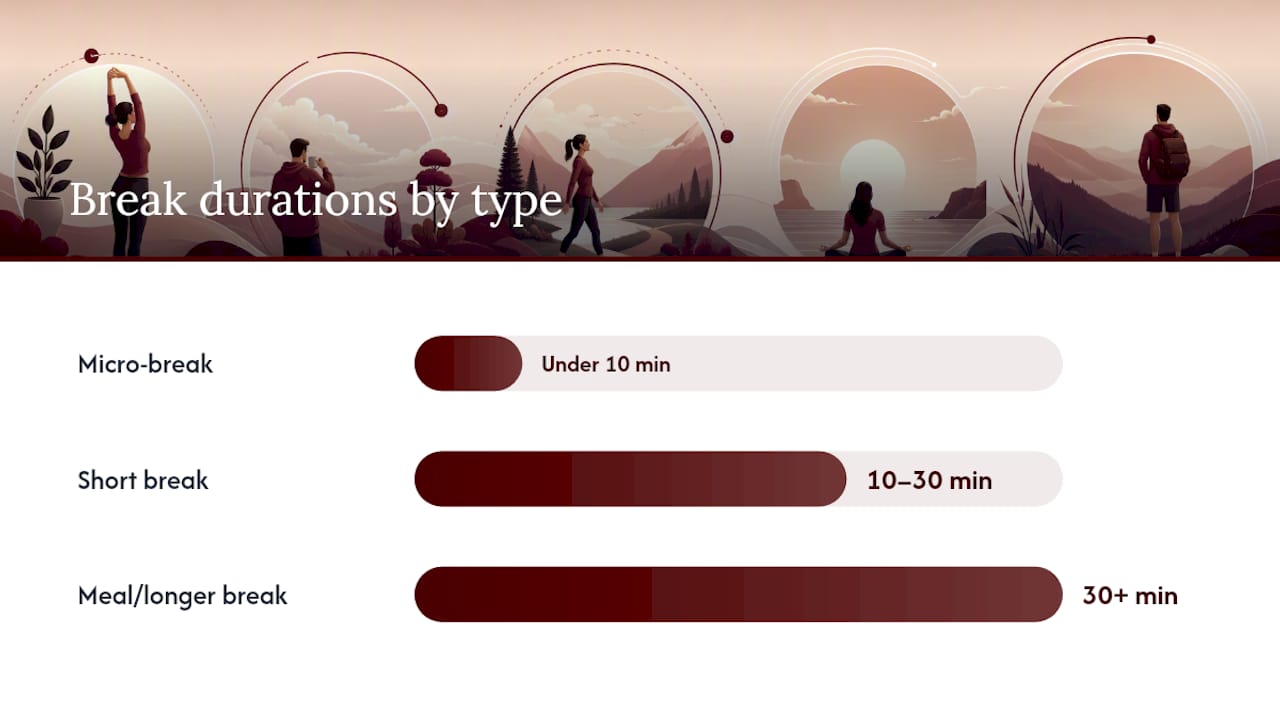
| Break type | Duration | Best after | One recommended activity |
|---|---|---|---|
| Micro-break | Under 10 min | Deep-focus sprint | Slow coffee preparation or 2-min stretch |
| Short break | 10–30 min | 2+ hours of sustained work | Walk outside or non-work conversation |
| Meal/longer break | 30+ min | Morning block or heavy meeting load | Full meal away from screen, light walk |
For remote workers, the absence of physical transitions (no commute, no hallway conversations) makes scheduling these breaks explicitly even more important. Office workers often get accidental micro-breaks through movement between spaces; remote workers usually do not.
- After a deep-work sprint: take a micro-break with a physical component.
- After a meeting-heavy morning: take a genuine 20-minute break before the afternoon block.
- During high-stress periods: prioritize short breaks with breathing or movement over social media.
What should you actually do during an intentional break?
The activity determines whether a break actually recharges you. Not all breaks are equally effective: activities that calm the nervous system and create genuine detachment from work demands produce the most recovery.
Movement: A 5-minute walk, even indoors, lowers cortisol and shifts your physical state. It does not need to be vigorous. The act of changing your environment is most of the benefit.
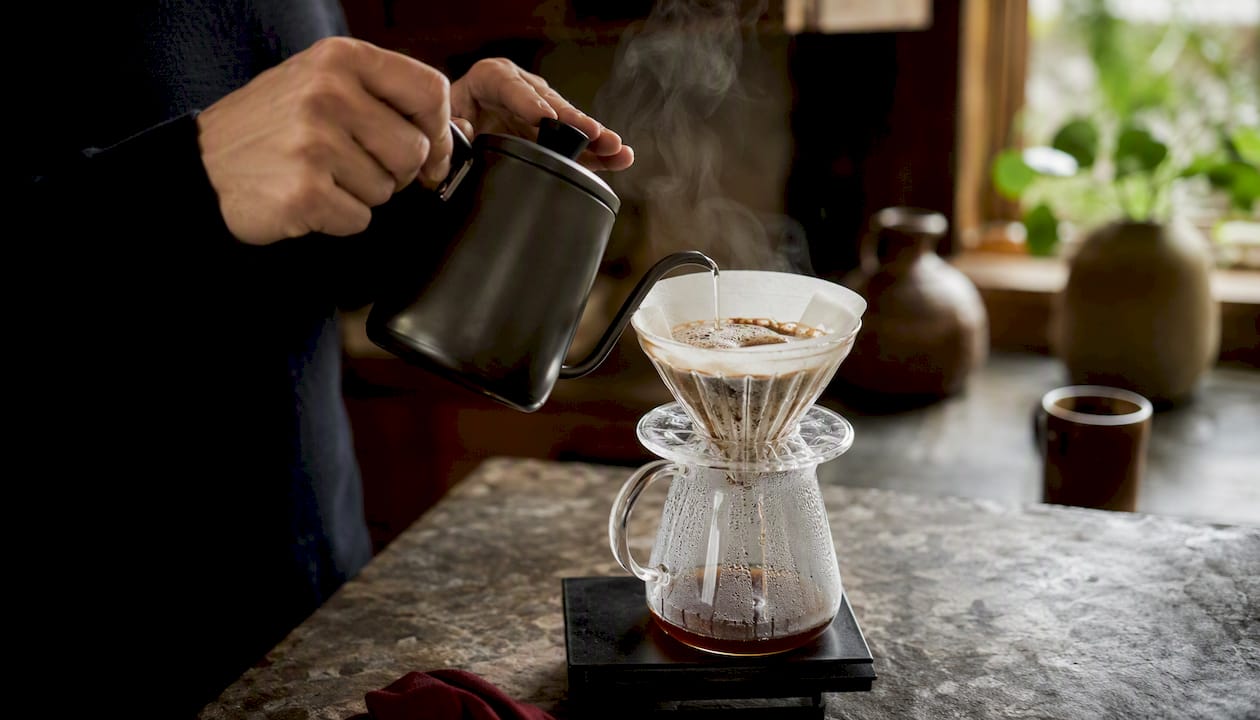
Sensory reset: This is where a deliberate beverage ritual earns its place. Grinding beans, measuring water temperature, and watching a pour-over bloom occupies your hands and senses without taxing your prefrontal cortex. High performers often use consistent sensory cues, a specific coffee ritual, a particular scent, a short breathing pattern, as transition markers between focused work and recovery. Pairing a sensory ritual with your remote work schedule makes the break repeatable because the cue becomes automatic.
Social (non-work): A 5-minute conversation about something unrelated to your tasks provides genuine psychological detachment. It also tends to improve mood, which carries forward into the next work block.
Cognitive reset: Light journaling (three sentences, not a diary entry) or doodling activates different neural circuits than analytical work. Some professionals use this to capture half-formed ideas that surfaced during a deep-work block.
Restorative: A 10–20 minute nap, when your schedule allows, produces measurable alertness gains. Guided breathing (box breathing: 4 counts in, 4 hold, 4 out, 4 hold) takes under 3 minutes and works anywhere.
Pro Tip: Pair a tactile or scent ritual with your break to make it self-reinforcing. When your brain associates a specific sensory cue with recovery, the ritual itself begins to trigger the relaxation response before the break even starts.
What to avoid: checking email, scrolling social media, or switching to a different work task. These activities keep your attentional system engaged and prevent the cognitive reset that makes breaks worth taking.
How to build a repeatable intentional break system
The gap between knowing breaks help and actually taking them is a systems problem. Here is a step-by-step approach that moves from awareness to habit in about two weeks.
Week one: track your current patterns
For seven days, log four data points after each work block:
- Task type (deep work, meetings, shallow/admin)
- Energy level before the block ended (1–5 scale)
- Break taken: yes/no, duration, activity
- Perceived benefit after the break (1–5 scale)
A simple spreadsheet with these columns is enough. The goal is not perfection; it is pattern recognition. Most professionals discover they skip breaks during their highest-energy morning blocks (when they feel fine) and then crash in the afternoon with no recovery buffer left.
| Column | What to record | Why it matters |
|---|---|---|
| Task type | Deep / meeting / shallow | Matches break type to cognitive load |
| Pre-break energy | 1–5 rating | Identifies depletion patterns |
| Break taken | Yes/no + duration | Reveals where breaks get skipped |
| Activity | Walk, coffee, scroll, etc. | Separates effective from ineffective breaks |
| Post-break energy | 1–5 rating | Quantifies which activities actually help |
Week two: schedule and pair
Use your tracking data to build a break schedule. Todoist’s research on work-rest patterns recommends pairing specific activities with scheduled times to replace aimless scrolling and sustain performance across the day.
Practical calendar rules:
- Set meeting defaults to 50 minutes (not 60) and 25 minutes (not 30). The buffer is your micro-break.
- Block one 10-minute break mid-morning and one mid-afternoon as recurring calendar events. Treat them as meetings you cannot move.
- Label each block with its activity so you do not have to decide in the moment.
Sample schedule for a deep-work day:
- 9:00–11:00 AM: Deep-work block
- 11:00–11:10 AM: Micro-break (walk or coffee ritual)
- 11:10 AM–1:00 PM: Second deep-work block or meetings
- 1:00–1:30 PM: Genuine lunch break, away from screen
- 1:30–3:30 PM: Meetings or collaborative work
- 3:30–3:40 PM: Micro-break (breathing or short walk)
- 3:40–5:00 PM: Shallow work / admin
For meeting-heavy days, the 50/25-minute meeting default does most of the work. Every gap between meetings becomes a built-in micro-break rather than a scramble to the next call.
Implementation checklist:
- Set 50-minute and 25-minute meeting defaults in your calendar app
- Add two recurring break blocks (mid-morning and mid-afternoon)
- Choose one activity per block in advance
- Review your tracking log at the end of each week and adjust
What gets in the way of taking intentional breaks?
Knowing the obstacles in advance is half the solution. The most common blockers fall into two categories: psychological and structural.
Psychological blockers:
- Guilt: The feeling that stopping equals falling behind. The cognitive reframe: recovery is part of the work, not a departure from it. IMD research frames energy as a renewable but limited resource. Professionals who stop before total depletion consistently outperform those who push through.
- “Always-on” mindset: Especially common in remote work, where the physical boundary between work and home disappears. Scheduled breaks with a named activity create the boundary that the office building used to provide.
Structural blockers:
- Back-to-back meetings: Use the 50/25-minute default. If your organization’s calendar culture defaults to full-hour blocks, request the change explicitly. Most managers agree when you frame it as a focus and output issue, not a comfort request.
- No private space: Desk-friendly alternatives work. Box breathing, a 2-minute stretch at your chair, or stepping to a window all count. You do not need a quiet room.
Scripts for manager conversations:
- “I’m experimenting with 10-minute breaks between deep-work blocks to protect output quality. I’d like to block those on my calendar. Does that work for you?”
- “Could we shift our team’s default meeting length to 50 minutes? It gives everyone a buffer to reset between calls.”
Red flags that breaks are not enough: If you feel chronically exhausted despite taking breaks, if your energy never recovers across a full week, or if you are experiencing persistent detachment from your work, micro-breaks are insufficient. Those are signals for a workload conversation with your manager or HR, not a scheduling adjustment.
How do you know if your breaks are actually working?
Three metrics tell you most of what you need to know:
- Vigor/energy rating: Average your pre- and post-break energy scores (1–5) across a week. A working break system produces a consistent post-break score at least one point higher than pre-break.
- Perceived focus: Rate your focus quality in the first 30 minutes after each break (1–5). Rising scores over two weeks indicate the system is working.
- Effective deep-work minutes: Count the minutes per day you spend in genuine focused work (no interruptions, no task-switching). This number should trend upward as your break system matures.
| Metric | How to track | Target signal |
|---|---|---|
| Post-break energy | 1–5 rating after each break | Consistently higher than pre-break score |
| Post-break focus | 1–5 rating in first 30 min after break | Upward trend over 2 weeks |
| Deep-work minutes | Daily count of uninterrupted focus time | Gradual increase week over week |
Iteration checklist:
- If post-break energy is flat, change the activity (try movement instead of social, or vice versa).
- If you are skipping breaks consistently, shorten them. A 5-minute break you take beats a 15-minute break you skip.
- If deep-work minutes are not increasing, check whether your break activities involve screens. Swap digital activities for physical or sensory ones.
- Reassess every two weeks. Small adjustments compound faster than a complete system overhaul.
What does the research actually say about work breaks?
The evidence base for intentional breaks is more solid than most workplace wellness advice. Here is what the key studies actually found.
The PLOS ONE meta-analysis on micro-breaks is the most cited quantitative summary: across multiple studies, micro-breaks produced effect sizes of d = .36 for vigor and d = .35 for fatigue reduction. Those are small-to-moderate effects, which is exactly what you would expect from a brief intervention. The finding is not that micro-breaks are transformative on their own; it is that they reliably move the needle on energy and fatigue across a wide range of workers and task types.
A systematic review published on ResearchGate categorizes breaks by initiator, duration, frequency, activities, and experiences, and links each feature to well-being and performance outcomes. One of its clearest findings: employee-initiated breaks produce better recovery outcomes than employer-mandated ones. Autonomy over when and how you break is not a soft preference; it is a design requirement.
Psychology Today’s review of break research reinforces the autonomy point and adds that mindless phone scrolling consistently fails to produce recovery. The brain stays in a reactive, stimulated state during passive social media consumption, which is why you can spend 20 minutes on your phone and feel no more rested than before.
Key studies at a glance:
- PLOS ONE meta-analysis: — Micro-breaks improve vigor (d = .36) and reduce fatigue (d = .35) across diverse worker samples.
- ResearchGate systematic review: — Break initiator and autonomy are core determinants of recovery quality.
- IMD: Deliberately designing break strategies (frequency, activities, autonomy) significantly increases break effectiveness.
- HBR: — Strategic short breaks deliver meaningful focus returns when longer recovery is not available.
- Psychology Today (diffuse mode): Pauses enable diffuse-mode thinking, which surfaces creative insight and improves decision quality.
Key Takeaways
Intentional work breaks, defined by purpose, timing, and a chosen activity, reliably improve energy, focus, and creative output when designed with autonomy and the right recovery activities.
| Point | Details |
|---|---|
| Define the break before it starts | Choosing your activity in advance separates a purposeful pause from mindless scrolling. |
| Match break type to task intensity | Micro-breaks suit deep-work sprints; longer breaks follow sustained multi-hour blocks. |
| Autonomy drives recovery | Employee-initiated breaks produce better outcomes than mandated ones; protect your break schedule. |
| Track for two weeks, then iterate | Monitor post-break energy and focus scores; swap activities when scores stay flat. |
| Espritkaffe as a sensory anchor | A deliberate coffee ritual from Espritkaffe pairs naturally with micro-breaks, making recovery repeatable through consistent sensory cues. |
The case for treating breaks as a professional discipline
The conventional wisdom frames breaks as a reward for finishing work. That framing is backwards, and the research makes it clear. Breaks are not what you earn after productivity; they are part of what produces it.
What most articles miss is the autonomy piece. The research on break initiators is unambiguous: when someone else decides when you rest, the recovery benefit shrinks. This means the most important design choice in any break system is not the duration or the activity. It is whether you own the decision. A 5-minute walk you chose is more restorative than a 15-minute mandated wellness break you resented.
The sensory anchor idea is also undervalued. Transition rituals, a specific brewing method, a particular scent, a consistent physical cue, do something that a calendar block alone cannot: they train your nervous system to shift states. Over time, the ritual itself becomes the signal. You do not have to convince yourself to stop working; the act of reaching for the kettle does it for you. That is the practical logic behind pairing a quality beverage ritual with a scheduled break. It is not about the coffee. It is about building a cue that your brain learns to trust.
Espritkaffe’s focus on purposeful, sensory-rich coffee rituals fits this framework directly. A slow, deliberate preparation is a transition ritual by design.
A ritual worth building into your day
The hardest part of any break system is not the scheduling. It is the moment when you are deep in a task and the calendar reminder fires. That is when the ritual matters most.
Espritkaffe’s freshly roasted beans, available in light, medium, and dark roasts, are built for exactly this moment. The preparation itself, grinding, measuring, waiting, is the break. Certified free of mycotoxins, heavy metals, mold, and yeast, Espritkaffe coffee is clean enough to drink without second-guessing what is in it, which matters when you are already managing enough variables in your day.
If you want a faster ritual for mid-morning micro-breaks, the Espritkaffe Instant Coffee delivers the same sensory cue in under two minutes. For something with an added functional edge, the Instant Coffee with Mushroom pairs well with a short afternoon reset. Either way, the ritual is the point. Pick one, schedule it, and let the sensory cue do the work of pulling you away from the screen.
Where to read more
- Meta-analysis of micro-breaks (PLOS ONE) — The primary quantitative evidence base for micro-break effects on vigor and fatigue.
- A guide to taking better breaks at work (Harvard Business Review) — Practical framing for professionals on why strategic short breaks pay off.
- How to make your work break work for you (IMD) — Research-grounded guidance on designing break frequency, activities, and autonomy.
- Work breaks: How can we use them to our benefit? (Psychology Today) — Covers break initiator research and the failure of mindless scrolling as recovery.
- Why the most productive thing you can do is pause (Psychology Today) — Explains diffuse-mode thinking and the creative case for deliberate pauses.
- Work-break effectiveness and recovery (Right As Rain, UW Medicine) — Accessible summary of which break activities actually calm the nervous system and which do not.