

The roast date tells you the exact day your beans were roasted. The best-by date is a manufacturer’s quality estimate, often set 12 to 24 months out, and it tells you almost nothing about how fresh that coffee actually is right now. If you want a good cup, chase the roast date, not the best-by.
Here’s the short version:
- Roast date = the birthday of the beans. It’s the number that matters.
- Best-by = a conservative “still technically fine” marker, not a freshness guarantee.
- Most specialty coffee tastes best 5 to 21 days after roasting, while ground coffee holds decent flavor for 3 to 5 months at room temperature or 1 to 2 years frozen.
At Espritkaffe, every bag gets a roast date because that’s the number that actually helps you plan your next cup.
Pro Tip: If a bag only shows a best-by date with no roast date printed anywhere, treat it as a red flag, not a reassurance.
Key Takeaways
Roast date, not best-by, is the number that actually tells you how fresh your coffee is and when it will taste best.
| Point | Details |
|---|---|
| Roast date is the real signal | It marks the exact day beans were roasted and drives the peak flavor window. |
| Best-by is a manufacturer estimate | Often set 12 to 24 months out, it can mask coffee that’s already 30 to 60+ days old. |
| Peak flavor window is narrow | Most specialty coffee tastes best 5 to 21 days after roasting. |
| Storage extends the timeline | Ground coffee lasts 3 to 5 months at room temperature, 1 to 2 years frozen. |
| Sensory checks beat guessing | Smell, look, and taste a small brew to judge staleness versus true spoilage. |
Table of Contents
- What Does Roast Date Mean on a Coffee Bag?
- What Is a Best-By Date, and How Is It Different?
- How Long Does Coffee Stay Fresh, and How Should You Store It?
- How Should You Use Roast Date and Best-By When Buying Coffee?
- How Can You Tell If Coffee Is Stale or Actually Spoiled?
- How Espritkaffe Labels Roast Date and What We Recommend
- Why I Stopped Trusting Best-By Dates Years Ago
- Frequently Asked Questions
- Sources
What Does Roast Date Mean on a Coffee Bag?
Roast date means exactly what it says: the calendar day the green beans went into the roaster and came out transformed. It’s the single most reliable number for judging where a bag sits in its flavor lifecycle, which is why roasters lean on it so heavily as a primary freshness indicator.
Right after roasting, beans release carbon dioxide in a process called degassing. This is most active in the first one to three days, and it’s why some roasters recommend a short rest before brewing. Skip the rest and you can get uneven extraction, especially with espresso.
- Degassing peaks in days 1 to 3, then flavor stabilizes.
- Peak flavor window typically runs 5 to 21 days post roast.
- Darker roasts often peak faster; lighter roasts hold longer.
Some roasters call the roast date a coffee’s “birth certificate.” It’s a fitting label. It doesn’t tell you if the coffee is good, but it tells you exactly how old it is, which is the piece of information a best-by date can’t give you.
Pro Tip: If your bag arrives and you plan to grind at home, pulling your own grind size around day 5 or later usually smooths out the gassy unevenness of very fresh beans.
What Is a Best-By Date, and How Is It Different?
A best-by (or best-before) date is a manufacturer’s recommendation, not a freshness clock. It’s typically calculated from the packaging or production date and set 12 to 24 months out, largely to cover the coffee legally and reassure buyers browsing a grocery shelf.
That long window is the problem. A bag can carry a best-by date almost two years away while the beans inside were roasted six weeks ago. The date isn’t lying, exactly. It’s just answering a different question than the one you’re asking.
Here’s the difference stated plainly:
- Roast date answers “how old is this coffee?”
- Best-by answers “how long can this technically sit on a shelf before quality drops noticeably?”
- Best-by dates are often set to extend perceived shelf life rather than to communicate peak flavor timing.
- A bag with only a best-by date gives you no way to know if you’re buying week-old coffee or six-month-old coffee.
How Long Does Coffee Stay Fresh, and How Should You Store It?
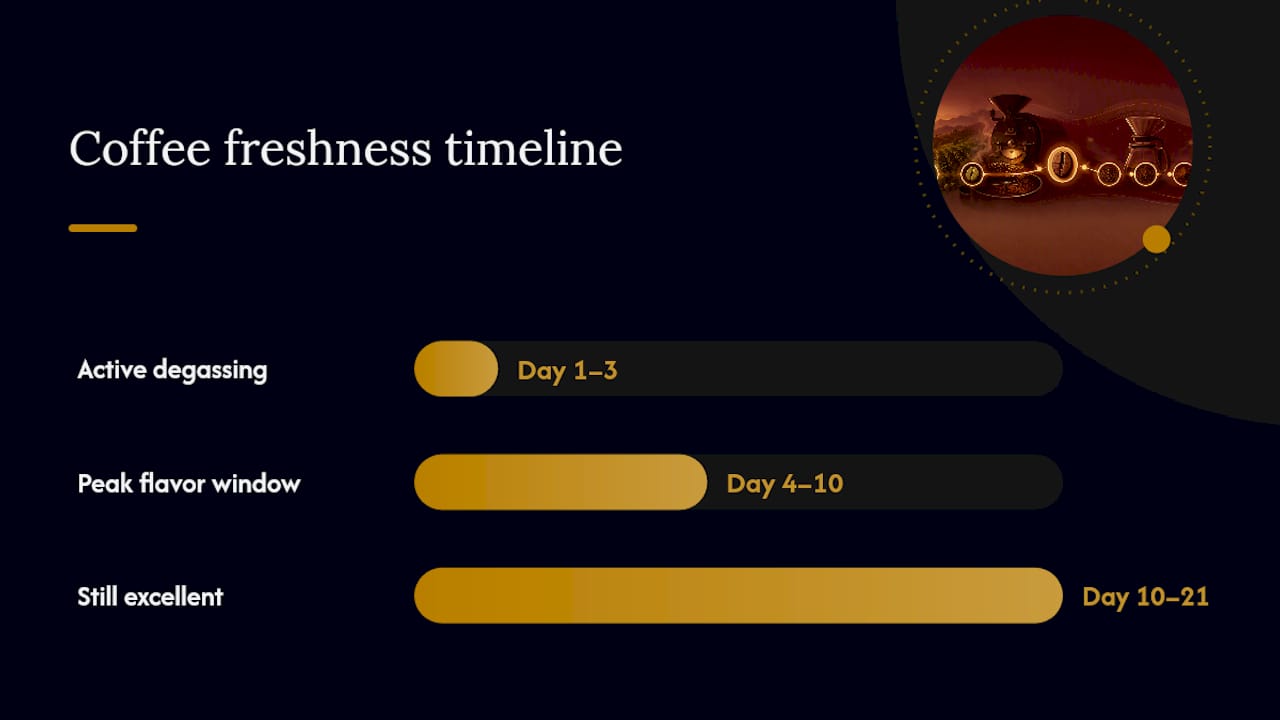
Freshness fades in stages, and storage decides how fast. Whole beans, kept sealed and away from light, generally follow a predictable arc from the day they’re roasted.
| Timeframe | What’s happening |
|---|---|
| Day 1 to 3 | Active degassing; can taste sharp or uneven, especially in espresso |
| Day 4 to 10 | Peak flavor window begins; aromatics are the strongest |
| Day 10 to 21 | Still excellent for most brew methods, filter and espresso alike |
| — | Noticeable flavor decline, still drinkable |
| — | Flat, muted flavor; not spoiled, just tired |
Espresso drinkers tend to want beans closer to the 10 to 21 day mark, since crema and extraction balance are less forgiving. Filter brewers have more room to work with, often getting good results from day 4 through day 14 and beyond.
Storage changes everything about how that timeline plays out:
- Room temperature, whole bean: best within 2 to 4 weeks of roast, kept in an airtight container away from heat and light. A proper cabinet setup makes a real difference here.
- Ground coffee, room temperature: 3 to 5 months before flavor drops off meaningfully, though you’ll notice aroma fading well before then.
- Freezer, whole bean or ground: up to 1 to 2 years with minimal flavor loss, provided it’s sealed tight.
The freezer trade-off is condensation. Every time you open a frozen bag, moist air hits cold beans, and repeated freeze-thaw cycles do more damage than the freezer itself. Portion coffee into small, sealed bags before freezing so you’re only opening what you’ll use in a day or two.
Pro Tip: Divide a fresh bag into weekly portions the day it arrives. It’s a five-minute habit that keeps the rest of the bag sealed and untouched by air.
How Should You Use Roast Date and Best-By When Buying Coffee?
Buying smart starts with a simple checklist:
- Prefer bags with a printed roast date over ones that only show a best-by.
- If no roast date is listed, assume the beans could already be 30 to 60 or more days old.
- Check for a best-by that’s suspiciously far out, which usually signals mass production rather than recent roasting.
Match your buying rhythm to how fast you drink coffee:
- Daily drinkers: buy weekly, or in small batches, so you’re always working through the 5 to 21 day peak window.
- Occasional drinkers: buy a 2 to 3 week supply and store it properly rather than stockpiling months of beans.
- Espresso brewers: aim for beans within 10 to 21 days of roast for the most consistent shots.
When roast date is missing, work backward from the best-by. Subtract the typical shelf-life window your source claims (often 12 months for whole bean retail bags) and you’ll get a rough estimate. It’s not precise, but it beats guessing blind. Buying from a roaster offering custom roast orders sidesteps this problem entirely since the beans ship shortly after roasting.
How Can You Tell If Coffee Is Stale or Actually Spoiled?
Stale and spoiled are not the same thing, and mixing them up leads to either wasted coffee or a bad cup you didn’t need to drink. A quick sensory check settles it fast.
- Smell: fresh coffee smells bright and aromatic; stale coffee smells flat or faintly cardboard-like; spoiled coffee smells sour, musty, or rancid.
- Look: check for visible mold, discoloration, or insect activity. Any of those means toss it immediately.
- Taste: brew a small cup. Stale coffee tastes muted or dull. Spoiled coffee tastes sharply off or bitter in a way that doesn’t match the roast.
Coffee rarely becomes unsafe to drink past its best-by date. Ground coffee remains safe well beyond that window; it just loses aroma and taste. The exception is genuine contamination, meaning visible mold or an odor that’s clearly gone rancid rather than simply faded.
Roughly 3 to 5 months at room temperature is the point where most ground coffee shifts from “a little flat” to “not worth brewing.” Past that, it’s a quality call, not a safety one.
How Espritkaffe Labels Roast Date and What We Recommend
Every bag we ship shows the roast date printed clearly, not buried behind a distant best-by. That’s a deliberate choice: we’d rather you know exactly how old your coffee is than trust a number set for shelf-stability purposes.
Our general guidance for customers:
- Let beans rest 2 to 4 days after roast before brewing, especially for espresso.
- Aim to finish a bag within 3 to 4 weeks of the roast date for the fullest flavor.
- Espresso drinkers should target the 10 to 21 day window; filter brewers have flexibility through day 21 and beyond.
- Once opened, reseal tightly and store away from heat, light, and moisture. If you grind in advance, keep portions small and use them within a few days.
Because we roast to order, the date on your bag is almost always recent. That’s the whole point of skipping mass-production timelines.
Why I Stopped Trusting Best-By Dates Years Ago
I used to glance at whatever date was printed on a bag and assume it meant something. It doesn’t, not in the way most people think. Once you start checking roast dates instead, you notice how much a “fresh” grocery bag can actually be months old. Now I label opened bags with a marker the day I crack them open, and I grind right before brewing. Small habit, real difference in the cup.
Frequently Asked Questions
Does coffee actually expire on its best-by date? No. Coffee rarely becomes unsafe after that date. It simply loses aroma and flavor gradually, especially once opened and exposed to air.
What does roast date mean if I’m buying whole beans versus ground? The same roast date applies to both, but ground coffee loses flavor faster since more surface area is exposed to oxygen. Whole beans hold their peak window longer.
How long does coffee last once I open the bag? Whole beans stay good for 2 to 4 weeks at room temperature if sealed properly. Ground coffee holds up for a shorter window, closer to 1 to 2 weeks for best flavor, though it remains drinkable for months.
Should I ever trust a bag with no roast date at all? Be cautious. If only a distant best-by date is printed, assume the beans could be over a month old and adjust your brewing expectations accordingly.
Sources
- Does Ground Coffee Expire—Or Just Lose Flavor? - Southern Living
- Coffee freshness explained: what roast date actually means | Trade Coffee
- Coffee Roast Date Explained: Read, Store, Brew | BrewedLate Coffee
- Roast Date vs Expiry Date — Are You Reading the Right One? - Lighthouse Coffee Roastery & Academy