

A coffee crop season is the annual window when cherries ripen and are ready to pick at a given origin — timing driven primarily by hemisphere, altitude, and rainfall patterns. In practical terms, it determines when fresh green coffee becomes available to roasters and, eventually, to you.
Here’s the quick global map:
- Northern hemisphere origins (Central America, Ethiopia, Kenya, Vietnam, India): harvest typically runs October–March
- Southern hemisphere origins (Brazil, Peru, Indonesia): harvest typically runs April–September
- Equatorial exceptions (Colombia): two distinct harvests per year (main crop October–January, mitaca April–June), creating near-year-round availability
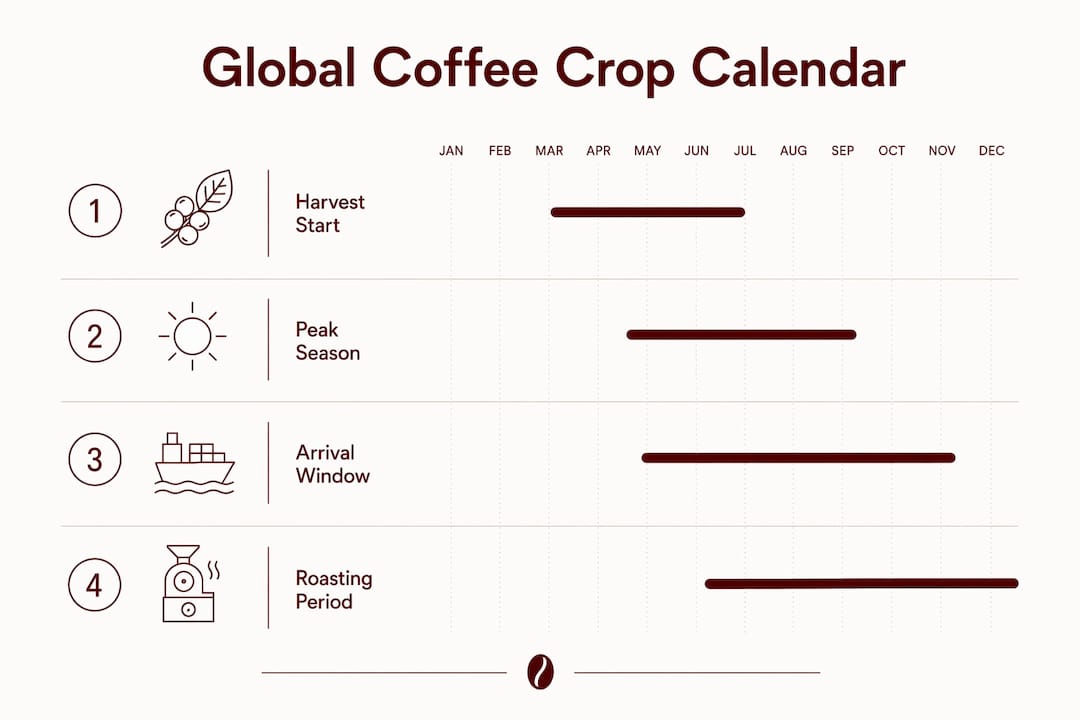
One thing to keep in mind: harvested coffee doesn’t land at a U.S. roaster overnight. The harvest-to-arrival lag runs roughly 3–6 months once you account for processing, drying, resting, and ocean freight. A bag labeled “fresh roast” in January could be from green coffee that was picked the previous spring.
Table of Contents
- What is coffee crop season, and what drives the timing?
- Origin-by-origin harvest calendar for major producing countries
- From field to roaster: how long does it actually take?
- How altitude and microclimate shift the harvest window
- How to buy the freshest cup: a practical checklist
- Key Takeaways
- The harvest calendar is the most underused tool in coffee buying
- Espritkaffe roasts with the harvest calendar in mind
- Authoritative resources for further reading
What is coffee crop season, and what drives the timing?
The short answer: coffee cherries ripen when temperature, rainfall, and daylight align — and those conditions are tied directly to where on the planet the farm sits.
Three forces set the clock:
- Hemisphere and dry season: Coffee plants flower after a dry period, then need 6–8 months for Arabica cherries to develop fully (8–11 months for Robusta, per ecophysiological research). The dry season triggers flowering, so Northern hemisphere farms flower in spring and harvest in fall/winter; Southern hemisphere farms do the opposite.
- Altitude: Higher elevations mean cooler air, slower sugar accumulation in the cherry, and a later harvest window. A farm at 1,800 meters in Guatemala picks weeks after a farm at 1,200 meters in the same region.
- Rainfall patterns: Irregular rains or a second dry period can trigger a second flowering cycle, which is exactly why Colombia gets two crops from its three mountain ranges.
The practical payoff for roasters and buyers is a rotating global harvest that keeps fresh-crop coffee available somewhere in the world every month of the year. No single origin can do that alone, but the calendar as a whole can.
Pro Tip: When a roaster lists “new arrival” on a bag, that phrase refers to the green coffee’s import date, not the roast date. Both matter, but they measure different things.
Origin-by-origin harvest calendar for major producing countries
The table below gives a quick-reference view. Arrival windows are approximate for U.S. importers and roasters; actual timing shifts by a few weeks depending on processing method and shipping route.
| Origin | Primary harvest months | Typical U.S. arrival |
|---|---|---|
| Brazil | May–September | August–December |
| Colombia (main) | October–January | January–April |
| Colombia (mitaca) | April–June | July–September |
| Guatemala | December–March | March–June |
| Costa Rica | November–April | February–June |
| Honduras | November–April | February–June |
| Ethiopia | October–January | January–May |
| Kenya (main) | October–December | December–March |
| Kenya (fly crop) | June–August | August–October |
| Rwanda / Burundi | March–July | June–October |
| Peru | April–September | July–November |
| Sumatra (Indonesia) | September–December | December–March |
| Java (Indonesia) | May–August | August–November |
| Sulawesi (Indonesia) | May–November | September–February |
| Vietnam | October–January | January–April |
| India | November–March | February–May |
Americas
Brazil is the world’s largest producer and harvests May–September, with peak activity in June–August. Mechanized strip-picking on large farms speeds processing, which is why Brazilian arrivals often hit U.S. warehouses by August and run through December. The sheer volume means Brazilian green coffee is rarely hard to find, but the freshest lots come from that August–October import window.
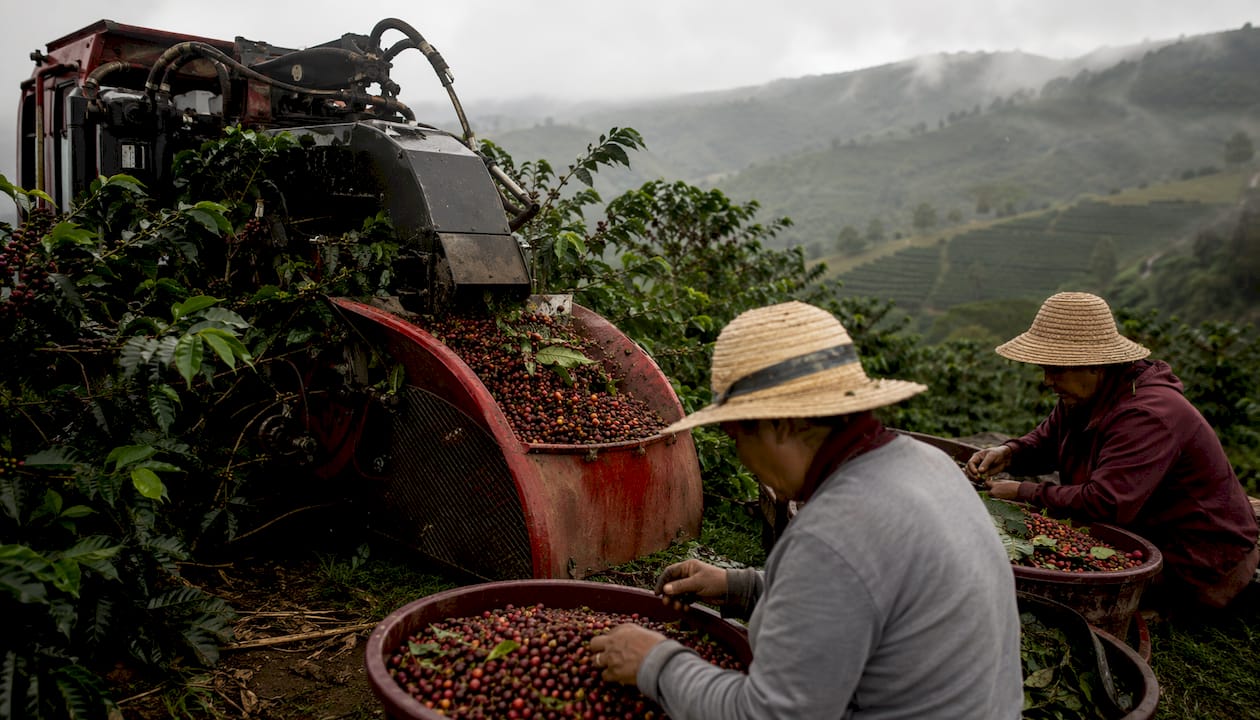
Colombia is the textbook equatorial exception. The main crop runs October–January; the mitaca (secondary crop) runs April–June. This split comes from Colombia’s three Andean mountain ranges, each with its own microclimate. The result: near-year-round Colombian availability for roasters who track both windows.
Guatemala, Honduras, and Costa Rica all follow a similar Central American rhythm: harvest December–March (with some farms starting in November), and U.S. arrivals landing February–June. The Antigua region of Guatemala and the Tarrazú region of Costa Rica are particularly well-known for high-altitude lots that ripen later in that window, often February–March.
Peru harvests April–September, overlapping with Brazil but producing primarily washed Arabica from high-altitude farms. U.S. arrivals typically run July–November.
Africa
Ethiopia, coffee’s birthplace, runs its main harvest October–January. Washed lots from Yirgacheffe and Sidamo tend to arrive in the U.S. January–April; natural-process lots from Harar can arrive slightly later. Ethiopia’s harvest is one of the most anticipated on the specialty calendar for its heirloom variety diversity.
Kenya runs a main crop October–December and a smaller fly crop June–August. Kenyan SL-28 and SL-34 lots from the main crop reach U.S. roasters December–March. The fly crop is smaller in volume but worth tracking for buyers who want Kenyan coffee mid-year.
Rwanda and Burundi both harvest March–July, with U.S. arrivals typically June–October. These origins are often overlooked compared to Ethiopia and Kenya, but their Bourbon-variety lots from high-altitude farms can be exceptional.
Asia and Pacific
Indonesia is three different harvest calendars in one country. Sumatra runs September–December (arrivals December–March), Java runs May–August (arrivals August–November), and Sulawesi runs May–November (arrivals September–February). The wet-hulled processing method common in Sumatra also affects timing and flavor profile.
Vietnam harvests primarily October–January, almost entirely Robusta. Arrivals reach the U.S. January–April. India’s harvest runs November–March for Arabica, January–March for Robusta, with arrivals February–May.
U.S. domestic coffee
Hawaii (primarily Kona) and California (small but growing) are the only U.S. states with commercial coffee production. Hawaii’s harvest runs roughly August–January; California’s small farms vary. For a deeper look at U.S. coffee-growing regions, the range of domestic options is more interesting than most buyers expect.
From field to roaster: how long does it actually take?
Picking a cherry is step one of a long chain. Here’s the realistic timeline from harvest to your roaster’s warehouse:
- Picking (days to weeks): Selective hand-picking of ripe cherries takes longer than mechanical strip-picking but produces more consistent quality. A single farm may pick the same trees multiple times over several weeks as cherries ripen at different rates.
- Processing (1–6 weeks): Washed coffees are depulped and fermented quickly, often 1–2 weeks total. Natural (dry) process coffees dry whole on raised beds for up to 6 weeks. Honey process falls between the two.
- Drying (2–4 weeks): Even washed coffees need drying time on raised beds or patios to reach stable moisture levels.
- Resting in parchment (30–60 days): Green coffee rests in its parchment layer before milling. This stabilizes moisture and protects flavor compounds.
- Milling and quality grading (1–2 weeks): Parchment is removed, beans are sorted by size and density, and lots are cupped and graded for export.
- Export logistics and ocean freight (4–8 weeks): Bagging, container booking, port handling, and the ocean crossing itself. A container from Central America to the U.S. West Coast takes roughly 2–3 weeks; from East Africa or Indonesia, longer.
Add it up and the aggregate harvest-to-arrival window is roughly 3–6 months. A coffee picked in December in Guatemala realistically arrives at a U.S. roaster in April at the earliest, often May or June. Central American arrivals commonly land February–June; Brazilian arrivals typically run August–December.
That lag is why “fresh crop” doesn’t mean “just picked.” It means the green coffee is from the current crop year and arrived recently, not sitting in a warehouse from the previous year’s harvest.

How altitude and microclimate shift the harvest window
Altitude is the single biggest variable within any origin. The reason is physiological: cooler temperatures at higher elevations slow the cherry’s metabolic processes, meaning sugar accumulates more gradually and ripening takes longer. The result is denser beans with more developed flavor complexity, which is why high-altitude lots command premiums in the specialty market.
A concrete example: in Guatemala’s Huehuetenango department, farms above 1,800 meters typically harvest in February–March, while farms in lower-altitude regions of the same country may finish picking by December. A buyer sourcing “Guatemalan coffee” without asking about elevation and harvest month could be comparing two very different products.
Colombia illustrates this even more dramatically. The three Andean ranges (Cordillera Occidental, Central, and Oriental) each have distinct rainfall and temperature patterns. The main crop runs October–January in most departments, but the mitaca crop April–June is more pronounced in some regions than others. Microclimates and altitude create meaningful variability inside a single origin, and high-altitude lots often harvest later and are prized for density and flavor complexity.
Pro Tip: When buying direct or from a specialty importer, ask three questions: What elevation was this grown at? What month was it harvested? What process was used? Those three answers tell you more about a lot’s flavor potential than the country name alone.
- Higher altitude = later harvest, denser bean, slower ripening
- Lower altitude = earlier harvest, faster turnaround, often lighter body
- Equatorial latitude = possibility of two harvest windows per year
- Microclimate variation (rainfall, cloud cover, slope aspect) can shift timing by 4–6 weeks within a single farm
For more on how coffee cultivation and altitude interact across different growing regions, the relationship between elevation and cup quality is worth understanding before you spend money on a micro-lot.
How to buy the freshest cup: a practical checklist
Fresh-crop coffee isn’t hard to find if you know what to ask. The problem is that most packaging tells you the roast date and nothing else, which only measures half the equation.
Questions to ask your roaster or seller:
- What crop year is this green coffee from?
- What month was it harvested?
- When did it arrive at the importer or roaster?
- What’s the roast date, and how long should it rest before brewing?
- What elevation was it grown at, and what process was used?
Reading the labels:
Roast date measures post-roast freshness. Green coffee degasses for roughly 7–21 days after roasting, then hits a peak window before staling. But a recent roast date from past-crop green coffee won’t deliver the brightness of a current-crop lot, no matter how fresh the roast. Crop year and roast date together tell the full story.
“New arrival” on a specialty roaster’s site typically means the green coffee just cleared customs and was roasted within weeks. That’s the signal you want.
Storage tips:
- Roasted coffee: store in an airtight, opaque container away from heat and light; use within 2–4 weeks of the roast date for peak flavor
- Green coffee (for home roasters): store in breathable grain-pro bags or burlap in a cool, dry space; avoid plastic bags that trap moisture
- Avoid the freezer for roasted coffee unless you’re storing a large quantity long-term in a vacuum-sealed bag
Buying strategy by type of buyer:
For home consumers, buying single bags from roasters who publish crop year and arrival dates is the simplest path to freshness. For small roasters, pre-ordering micro-lots directly from importers before a harvest lands locks in the best lots before they sell out. Custom roast orders also let you schedule delivery around peak freshness windows rather than buying whatever’s on the shelf.
Key Takeaways
Coffee crop season is a global, rotating calendar: no single origin is always in season, but somewhere in the world, fresh coffee is always being harvested.
| Point | Details |
|---|---|
| Definition | A coffee crop season is the annual harvest window when cherries ripen at a given origin, driven by hemisphere, altitude, and rainfall. |
| Hemisphere rhythm | Northern hemisphere origins harvest October–March; Southern hemisphere origins harvest April–September. |
| Equatorial exceptions | Colombia produces two crops per year (main crop October–January, mitaca April–June) due to varied microclimates. |
| Harvest-to-arrival lag | Processing, drying, resting, and shipping add roughly 3–6 months between picking and U.S. arrival. |
| Freshness signals | Check both crop year and roast date; a fresh roast from past-crop green coffee won’t match current-crop flavor. |
| Espritkaffe | Espritkaffe sources with crop year and arrival windows in mind, so you know exactly what season you’re drinking. |
The harvest calendar is the most underused tool in coffee buying
Most coffee drinkers track roast date. Fewer track crop year. Almost nobody tracks harvest month and arrival window together, which is where the real freshness picture lives.
The conventional wisdom says “buy freshly roasted coffee.” That’s true but incomplete. A bag roasted last week from green coffee that’s been sitting in a warehouse for 18 months will taste flat compared to a bag roasted three weeks ago from a current-crop lot that arrived two months after harvest. The roast date is the last chapter. The harvest calendar is the whole story.
What I find genuinely underappreciated is how the rotating global calendar rewards buyers who pay attention. When Central American arrivals are fresh in spring, Ethiopian lots from the fall harvest are still in their prime. When those fade, Kenyan and Colombian lots are arriving. There’s no dead season for fresh coffee if you know where to look and when to buy.
The altitude variable is similarly overlooked. Two bags from the same country, same roaster, same process, but one from 1,200 meters and one from 1,900 meters can taste like different origins entirely. The higher lot ripens later, arrives later, and often needs a few extra weeks of rest post-roast. Knowing that changes how you buy and how you brew.
Espritkaffe roasts with the harvest calendar in mind
Espritkaffe tracks crop years, arrival windows, and harvest months as part of how it selects and roasts every lot. When you order from Espritkaffe, you’re not getting whatever green coffee happened to be in stock. You’re getting coffee sourced to match the current harvest cycle, roasted to order, and shipped with the freshness window built in.
That’s the concrete difference between a roaster who publishes a roast date and one who can tell you the harvest month, the elevation, and the arrival date. Espritkaffe does both. If you’ve read this far and you want to taste what a current-crop lot actually feels like in the cup, the next step is simple: explore Espritkaffe’s current offerings and look for the crop year detail on each listing. That’s where the calendar becomes a cup.
Authoritative resources for further reading
These sources were used to build the calendars and timelines in this article. Each one is worth bookmarking if you want to go deeper.
- NCA Lifecycle of Coffee: Best for understanding the full plant lifecycle, from planting to first harvest (3–4 years) and productive lifespan by variety.
- CoffeeTrove Harvest Calendar: Interactive origin-by-origin calendar; strong on hemisphere mapping, equatorial exceptions, and processing-to-arrival timelines.
- JayArr Coffee Harvest Calendar: Roaster-focused write-up covering arrival windows for U.S. buyers, crop year vs. roast date, and specialty sourcing strategy.
- MyEspressoLab Harvest Guide: Practical country-by-country month ranges for Central America, Southeast Asia, and South America.
- EOLSS Ecophysiology of Coffee: Academic source on Arabica and Robusta flowering-to-ripening timelines (6–8 months and 8–11 months respectively) and rainfall’s role in bud differentiation.
- My Coffee Explorer Harvest Seasons Guide: Consumer-facing breakdown of freshness windows, new crop vs. past crop flavor differences, and seasonal buying strategy by quarter.
- Bean Indigo Coffee Calendar: Continent-by-continent varietal and harvest period breakdown; useful for buyers who want to match variety to season.